Product guide ·
Coat Racks with 2 Shelves: Straight Frame (TVD-2981) or Canopy Top (TVD-2982)
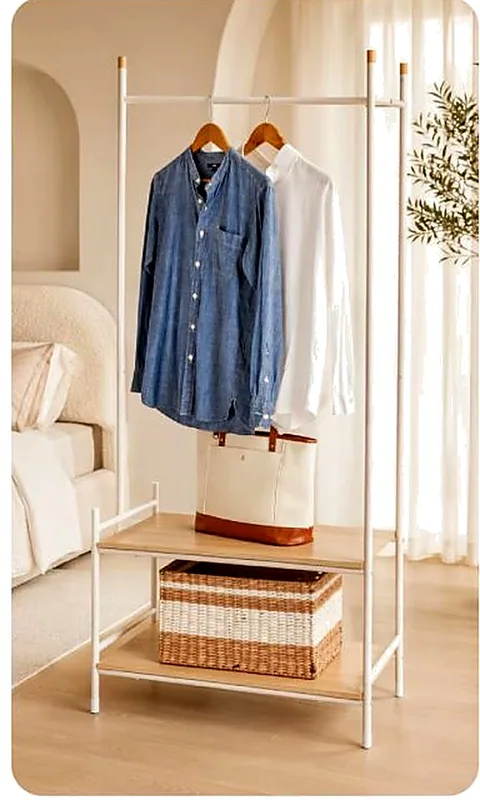
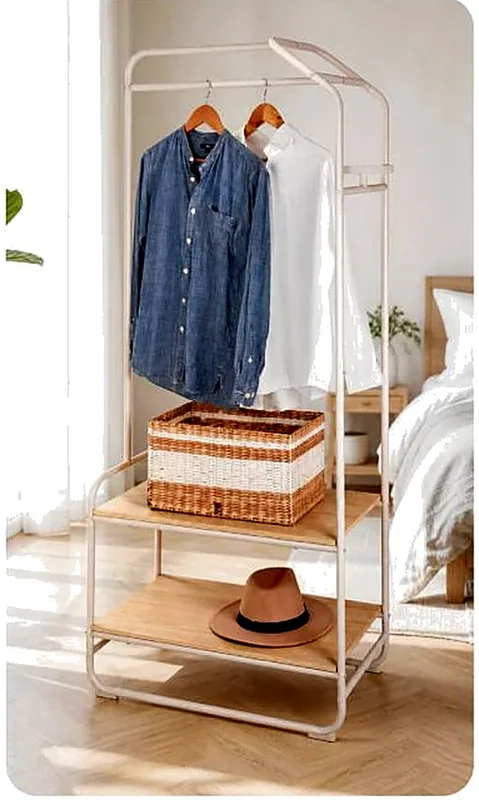
Two entryway racks share the same footprint, the same rail-and-shelf layout and the same white metal frame. Here is how to tell them apart and which one suits your floor, hallway or guest room.
Two racks, one specification
Coat Rack with 2 Shelves – Straight Frame (TVD-2981) and Coat Rack with 2 Shelves – Canopy Top (TVD-2982) are built to the same plan. Both measure 70 cm wide and 40 cm deep. Both have a hanging rail with two wood shelves, and both use a white metal frame. They differ in name, in the shape of the top, and in height: the straight frame is 165 cm tall, while the canopy top is 170 cm with a curved top rail.
That makes this a short decision. If your buyers care about silhouette, you are choosing between a square, upright rack and a rack with a gently curved crown. If they care about floor space, there is nothing to choose, because the footprint is identical.
What the shared specification means in practice
- 70 x 40 cm footprint. A rack of this width fits beside a front door, in a hallway niche, or against the end wall of a corridor without blocking a door swing. At 40 cm deep it holds coats at a sensible distance from the wall.
- Hanging rail. A single rail carries coats, jackets and scarves. Winter garments are bulky, so ask on the quote what load the rail and shelves are rated for before you plan how many hangers to stock.
- Two wood shelves. The shelves give you a place for hats, gloves, bags or boxed items. Whether the wood is solid, veneer or laminate on board is confirmed on your written quote, because it changes how the shelf wears and which Canadian rules touch it (see below).
- White metal frame. White reads clean in a bright entry and photographs well for retail listings. It also shows scuffs from boots and bags, so ask about the finish and whether touch-up is practical.
How the two differ, and who each one suits
| Question | TVD-2981 Straight Frame | TVD-2982 Canopy Top |
|---|---|---|
| Height | 165 cm | 170 cm |
| Top | Straight rail | Curved top rail |
| Footprint | 70 x 40 cm | 70 x 40 cm |
| Shelves | 2 wood shelves | 2 wood shelves |
| Frame | White metal | White metal |
Choose the straight frame when the rack goes under a window sill, a wall-mounted shelf or a sloped ceiling, or when the buyer wants a plain, modern look. It is also the easier fit for a rental suite where the tenant brings their own furniture style.
Choose the canopy top when you want a little more presence. The curved rail gives a softer outline, which tends to suit boutique retail displays, guest houses and show-home staging. The extra 5 cm of height also gives longer coats a little more room, though hem length depends on the hanger, so check against your own stock.
Mixing both in one order
Because the footprint and finish match, you can put both racks in one order without any layout change. A property manager fitting out several units might take the straight frame for studio suites and the canopy top for larger suites, so tenants get a visible step up without a different part list. A retailer can display one of each side by side and let customers choose the shape. Minimum quantities per colour or size are confirmed on your written quote, so tell us your split when you ask.
How to specify it
Use this list when you request a quote. It is adapted from what we confirm on every furniture order:
- Overall dimensions and weight capacity of the rail and of each shelf.
- Frame and shelf materials, including whether the wood is solid, veneer or laminate on board.
- Assembled or knock-down supply, hardware included, and the language of the instructions.
- Whether wall anchors or a stabilising fixing come with the rack, since tall, narrow racks can tip when a rail is loaded unevenly.
- Carton dimensions, gross weight and loading quantity per container.
- Minimum order quantity per model, and lead time.
Product pages show full specifications to signed-in buyers, so a free account is the quickest way to see them.
Canadian use notes
Canadian entries are wet half the year. Snow on boots, wet gloves and damp coats sit on a rack for hours, so ask how the metal finish handles moisture and whether the shelf edges are sealed. In heated buildings on the Prairies and in central Canada, winter air is dry, and wood parts can move slightly; coastal British Columbia and Atlantic Canada are humid. Neither is a reason to avoid wood shelves, but it is a reason to ask about the finish.
Rules that can apply, written as requirements: a consumer product must not be a danger to human health or safety under the Canada Consumer Product Safety Act, and Health Canada can order recalls. Paint and coatings on furniture must meet the lead and mercury limits in the Surface Coating Materials Regulations. If the shelves are made from particleboard, MDF, hardwood plywood or laminated board, the Formaldehyde Emissions from Composite Wood Products Regulations require third-party certification and labelling. Prepackaged consumer goods need bilingual product identity and net quantity under the Consumer Packaging and Labelling Act, and instructions sold into Quebec must be available in French. We do not hold a certification mark for either rack: we confirm certification status and supply the documents with the quote before you order. Rules change, so check with your local authority or customs broker. This is not legal advice. Our compliance and import guide for shoe and coat racks goes through the documents in more detail.
Other racks to compare
If neither shape fits, look at Coat Rack with Shelves – Wide Model (TVD-2983), which is 80 cm wide with a hanging rail, a shelf and a half tray, or Clothes Racks with Shoe Shelf (TVD-2984) if you want hooks and a lower footwear shelf. For a pure garment display without shelves, see Clothes Racks – Garment Rail (TVD-2985). The whole range sits on our Shoe & Coat Racks page.
How ordering works
Every order starts with a written quote covering the price for your quantity, specifications, certification status, packing, lead time and delivered cost to your address. Send a quote request with the codes and quantities, ask for a sample if you want to see the finish first (sample cost is usually credited to the first order), and read how ordering works for the payment steps: 30% deposit, 70% before release. Use the landed cost calculator to plan a budget, and the sales tax guide for tax by province. Delivery is to your site, store or warehouse anywhere in Canada.