Certification guide ·
Low Media Sideboard (TVD-5578): Canadian Certification and Compliance Checklist
No certificate is on file for this sideboard, so this guide lists the documents a Canadian buyer should request, who issues them and what happens when one is missing.
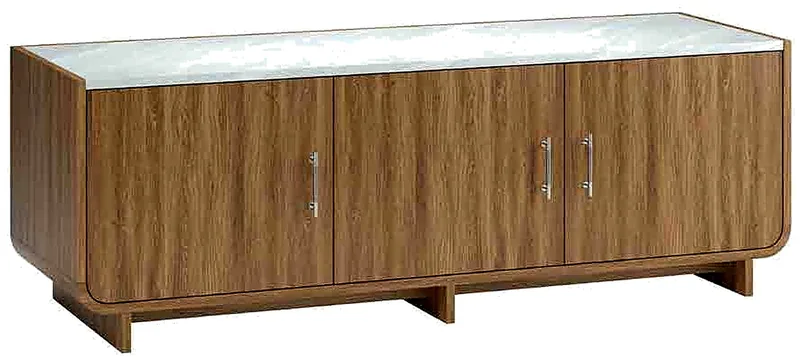
A sideboard is not a regulated appliance, so there is no single mark to look for. Compliance for the Low Media Sideboard – Walnut Look (TVD-5578) is a set of documents about its panels, its finish and its labels. The product has a marble-look top, rounded wood-grain doors and a walnut-look finish. No certification is on file for it. We confirm the status and supply the documents with the quote before you order. This page explains which documents to ask for. For the buying side of the product, see the TVD-5578 wholesale guide.
The rules that apply to this sideboard
Composite wood. This sideboard is made with composite wood panels. Canada's Formaldehyde Emissions from Composite Wood Products Regulations, in force since 2023, cover hardwood plywood, particleboard, MDF and laminated products, which includes furniture made from those panels. The panels must meet emission limits, be certified by an approved third-party certifier and be labelled. The usual document to request is the TSCA Title VI or Canadian compliance certificate; they are aligned.
Surface coatings. The Surface Coating Materials Regulations limit lead (90 mg/kg) and mercury in paints and coatings on furniture. A walnut-look finish that is a coating, lacquer or stain falls under that rule.
Consumer product safety. The Canada Consumer Product Safety Act covers consumer products generally: it prohibits products that are a danger to human health or safety, requires incident reporting and allows recalls. Health Canada enforces it.
Labelling. The Consumer Packaging and Labelling Act requires bilingual product identity and net quantity on prepackaged consumer products, plus the dealer's name and place of business. In Quebec, the Charter of the French language requires that labels, instructions, manuals and warranty documents be available in French.
Document checklist
| Document | Why you need it | Who issues it |
|---|---|---|
| Composite wood formaldehyde certificate | Shows the panels meet Canadian emission limits and are third-party certified | Approved third-party certifier, passed on by the factory |
| Coating test report (lead and mercury) | Shows the finish meets coating limits for furniture | Accredited laboratory |
| Panel and surface description | Confirms whether the top is stone-look film, laminate or veneer and which board sits beneath | Factory, written on the quote |
| French instructions and warranty text | Needed for Quebec buyers and retailers | Factory or us, confirmed on the quote |
| Dealer and product labelling proof | Retail listing and inspection | Importer of record, with our help |
| Customs classification | Sets duty and taxes on the delivered cost | Our customs broker |
Provincial differences
Quebec adds French on labels and manuals under the Charte de la langue française; the stuffing permit law that once applied there was repealed in December 2021, so nothing more is needed for a plain sideboard. A sideboard has no padding, so nothing beyond French labels applies unless a cushion or padded item is added. A hotel or institutional operator may add purchasing rules of its own, so ask what the tender names.
What goes wrong when a document is missing
- A retailer's compliance team refuses to list the product until the formaldehyde certificate is attached.
- A hotel group's procurement office pauses payment because the coating report is missing.
- A Quebec store sends back cartons whose instructions are only in English.
- Under the consumer product safety law, an unsafe product can be recalled, which makes missing paperwork a business risk and not only an admin one.
How we handle it
We do not claim a mark we cannot show. On every quote we state the certification status of the item, list the documents we will supply, and say who issues them. If a document does not exist yet, we can ask the factory to obtain it before production, or we tell you and you decide. A customs broker confirms classification before we quote a delivered cost. The CE mark, if a factory mentions it, is not accepted in Canada as proof of compliance. Rules change, so confirm with the authority, your inspector or your customs broker. This is not legal advice.
Questions to put to the factory in writing
- Which panels are used in the top, the carcass and the doors, and do all of them carry the third-party composite wood certificate?
- Is the marble-look surface a coating, a film or a laminate, and is it covered by the same coating report as the walnut-look finish?
- Are the same board and finish used in every production run, or can they change between batches?
- What French text exists for the instruction sheet and warranty today, and what would need translating?
Written answers go on the quote file so that your retailer, inspector or customer can see them later.
Pairing with other furniture
The same checklist applies to the other board-based pieces in the line, such as the TV Unit – Wavy-Door Oak Look (TVD-5568), the Coffee Table with Drawer – Oak Look (TVD-5570) and the TV Stand – White with Spindle Legs (TVD-5563). Our assorted home furniture compliance and import guide compares them. For marks that apply to electrical products, not furniture, see CSA, cUL and cETL marks explained.
Next steps
Ask for the documents above on the quote, then read how ordering works and request a quote. Payment is 30% deposit and 70% before release, and the sales tax by province guide explains tax by province.