Product guide ·
Six-Cube Wood-Look Bookcase (TVD-6339): Open and Door-Fronted Cubes for Canadian Buyers
Six cubes, some open and some behind doors, in a wood-look finish. Here is who buys the Six-Cube Wood-Look Bookcase, how the doors change the specification and what to confirm.
The idea behind the Six-Cube Wood-Look Bookcase
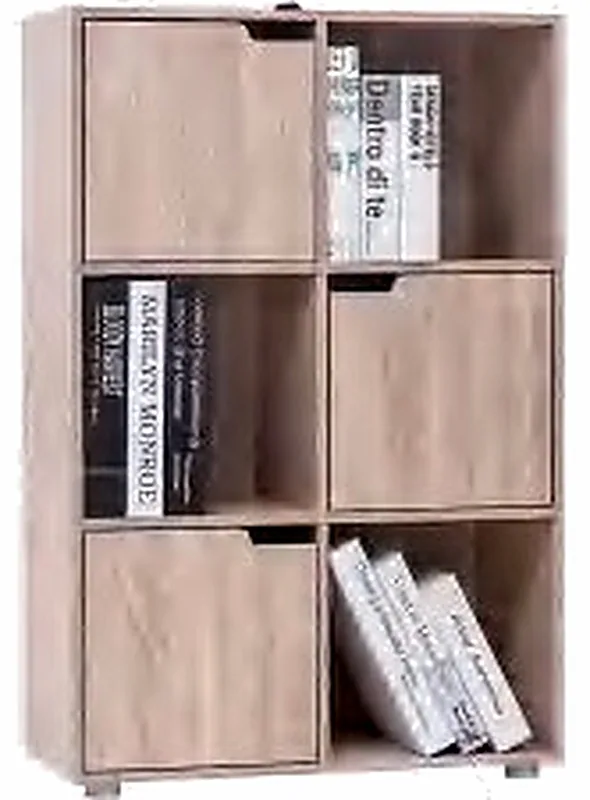
Most cube bookcases are all open, which is fine for display and poor for anything that looks untidy. The Six-Cube Wood-Look Bookcase (TVD-6339) mixes two cube types: open cubes and door-fronted cubes, in a wood-look finish, with space for books and boxes. It is the product in our bookcases and shelving line for buyers who want to show some things and hide others without buying a separate cabinet.
The listing gives these facts only. Overall dimensions, door style, hinge type, cube size and which positions carry doors are confirmed on your written quote, and a sample is the quickest way to judge the proportions.
Where it works
Retailers, offices and schools are the typical buyers in this line; here is how each reads the door-fronted layout.
- Hotel and guest-suite fit-outs. Open cubes hold books, a plant or a decorative object while doors close over spare blankets, towels or other items guests should not see. Design teams often want a piece that looks residential, and wood-look reads that way.
- Offices and clinics' waiting rooms. Doors cover files, forms and supplies while the open cubes display brochures or books. A reception area looks tidier with this mix than with an all-open unit.
- Home and rental retail. A shopper furnishing a living room wants storage that hides the router, game consoles or children's toys. Retailers can position the six-cube unit between a basic cube shelf and a full cabinet.
- Schools and libraries. Teachers use the closed cubes for supplies and the open ones for current reading.
What doors add, and what to ask about them
Doors turn a simple shelf into a product with moving parts, so the questions multiply. Ask what the hinges are made of and how many are fitted per door, whether the doors close with a magnet, a catch or friction, whether the door can be reversed, and what the rated load is for the cube behind the door. In a school or a childcare room, ask whether the doors can pinch fingers. In a hotel, ask how many open-and-close cycles the hinges are designed for; that number is confirmed on the quote, not assumed. If the doors are panel-based, the board type behind the finish needs the same documents as the frame.
Wood-look finish and the Canadian panel rule
A wood-look finish often sits on a manufactured panel, but the listing does not say so. If the version you order uses hardwood plywood, particleboard, MDF or a laminated product, then Canada's Formaldehyde Emissions from Composite Wood Products Regulations apply: panels must meet emission limits, be certified by an approved third-party certifier and be labelled, and the compliance certificate (TSCA Title VI and Canadian certificates are aligned) is the document to ask for. A doored unit has more panel area than an open one, so there is more to document. Coatings fall under the Surface Coating Materials Regulations, with limits on lead (90 mg/kg) and mercury on furniture and children's products. No certification mark is on file for this product, and we confirm certification status and supply the documents with the quote before you order. Read the composite wood guide for bookcases and shelving for the full list. Rules change; confirm with the authority or your customs broker. This is not legal advice.
How to specify it: checklist
- Confirm overall width, height and depth, and which of the six cubes carry doors.
- Ask for the internal cube size, open and door-fronted, and the load per cube.
- Confirm door construction, hinge type, closing method and whether a door stop is fitted.
- Confirm the board material behind the wood-look finish and the finish reference.
- Ask about wall anchoring and whether anchors are included.
- Ask whether hardware is included, how long assembly takes and whether instructions are in English and French.
- Get carton dimensions, gross weight and loading quantity per container; doored units sometimes ship in more than one carton.
- Confirm the minimum order and lead time.
How it compares with other units
The Cube Bookcase – Black (TVD-6331) is entirely open and 1040 mm wide; it is the better display piece. The Cube Bookcase with Storage Bins (TVD-6332) hides small items in bins rather than behind doors, and its light oak finish is warmer. The Industrial Bookshelf – X-Frame (TVD-6342) is a tiered steel and wood-look design with no doors and is the choice for a visibly industrial space. For steel, glass and coated finishes, our bookcase compliance guide covers the paperwork. A colour range is available in the cube shelf range led by TVD-10861.
Canadian use notes
Doors hang on hinges, and a long ocean and truck journey is hard on moving parts; plan a quick check of door alignment on receipt, before the units go out to customers. Heated Canadian interiors are dry in winter, which can shift wood-look boards slightly, so allow cartons to warm to room temperature before assembly. Freight from Asia lands at Vancouver or Prince Rupert, then goes by rail to the Prairies, Toronto-area and Montreal terminals. See the Canada delivery hub, the sales tax guide and the landed cost calculator when planning landed cost.
How ordering works
Orders are quoted in writing for your quantity and delivery address, covering specification, certification status and documents, packing, lead time and delivered cost. Many lines have low trial quantities, most items have samples with the cost usually credited to the first order, and goods from several factories can share one container. Payment is 30% deposit and 70% before release, with delivery to your site, store or warehouse across Canada. See how ordering works and send a quote request. A free account shows the full specification on the product page; the line page shows the rest of the range.