Certification guide ·
Wooden Dining Table 140 cm (TVD-5704): Which Canadian Rules Apply and Which Documents to Ask For
A dining table is not an electrical product, but it still meets Canadian rules through its finish, its panels and its labelling. Here is the document trail for TVD-5704.
Where this table stands today
Wooden Dining Table – 140 cm (TVD-5704) has no certification mark on file with us. That is not unusual for a plain furniture item, but it means we do not describe it as certified, listed or approved for anything. What we do is confirm the certification status and supply the documents with the quote before you order. If a factory report is missing, we tell you at that stage, not after the container lands.
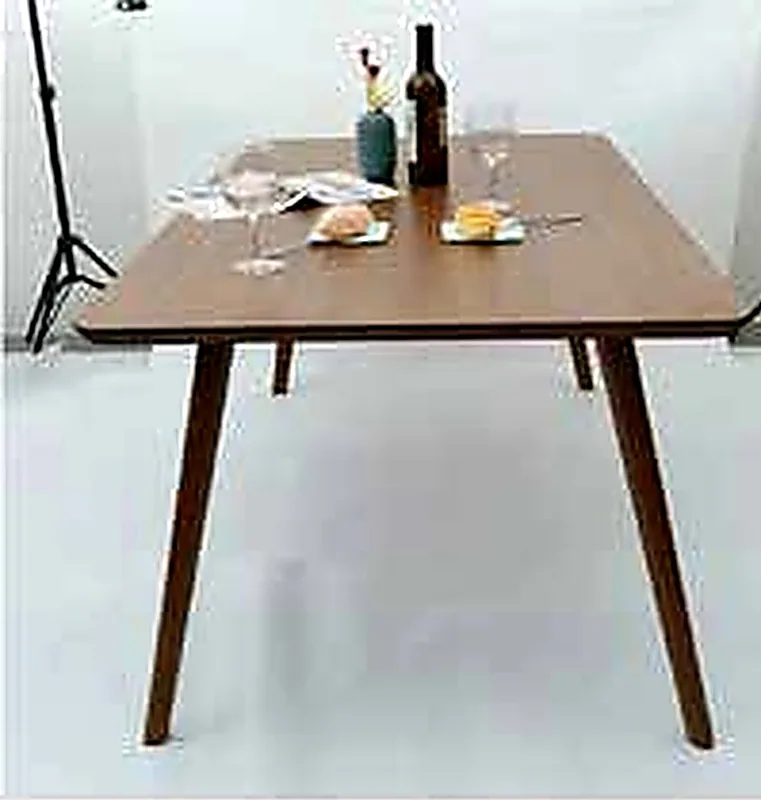
The product is a 140 x 80 x 75 cm table with angled solid legs and a walnut-tone finish. The rules that matter follow from those three facts. Our companion article, the wholesale buying guide for TVD-5704, covers sizing and ordering; this one stays on compliance.
The rules that can apply to a finished wooden table
- Canada Consumer Product Safety Act. Consumer products must not be a danger to human health or safety, incidents must be reported, and Health Canada can order a recall. A table sold into households or hospitality falls inside that general duty.
- Surface Coating Materials Regulations. The paint, stain or lacquer on furniture must stay within the limits for lead (90 mg/kg) and mercury. A walnut-tone finish is a coating question until the factory proves otherwise.
- Formaldehyde emissions from composite wood. Hardwood plywood, particleboard, MDF and laminated products must meet emission limits, be certified by an approved third-party certifier and be labelled. If the top or an under-frame is built from one of these panels, the certificate belongs in your file. Solid wood tops are a different case.
- Consumer Packaging and Labelling Act. Prepackaged consumer goods need English and French product identity and net quantity, plus the dealer's name and place of business.
- Quebec Charter of the French language. Labels, instructions, manuals and warranty documents must be available in French, with French at least as prominent as any other language. Retailers in Quebec will ask for this before they list a product.
The listed features include no plug, motor or light, so this is not an electrical product as described. If the version you order has a built-in power outlet or a light, it must carry a certification mark from a body accredited by the Standards Council of Canada, such as CSA, cUL or cETL, or a field evaluation label; a US-only mark is not enough. See CSA, cUL and cETL marks explained. Rules change, so confirm with your authority, inspector or customs broker; this is not legal advice.
Document checklist for TVD-5704
| Document | Why you need it | Who issues it |
|---|---|---|
| Coating test report (lead, mercury) | Shows the finish stays inside the Canadian limits for furniture coatings | Independent test laboratory, requested through the factory |
| Formaldehyde certificate, if any panel is composite wood | Third-party certification and labelling are required for plywood, particleboard, MDF and laminated panels | Approved third-party certifier |
| Construction statement for the top and legs | Tells you whether the top is solid, veneer or laminate, so you know which rules above apply | Factory, confirmed on our written quote |
| French and English carton and instruction labels | Needed for bilingual labelling and for Quebec sales | Prepared with you before printing |
| Electrical mark or field evaluation label, only if a powered feature is added | Inspectors can refuse uncertified electrical equipment | Accredited certification body |
CE or Canadian marks
A European CE mark does not prove compliance in Canada. Canada does not recognise it as proof for electrical, gas or consumer products, so a table that arrives with CE paperwork still needs the Canadian items above. Do not accept CE alone as the answer to a coating or composite wood question.
Provincial differences that change the paperwork
Quebec is the main one. Its French-language rules reach labels, manuals and warranties, so a Quebec distributor should see French text before the first pallet ships. Quebec no longer has a permit and label rule for upholstered and stuffed articles, since it was repealed on 9 December 2021. A wooden table with a solid top is not a textile article anyway; if you pair it with upholstered chairs or fitted seat pads, the Textile Labelling Act applies to those items.
What happens when something is missing
- A store or hospitality group may refuse to list a table whose coating or panel documents are missing.
- A building owner or franchisor may ask for documents after install, which is harder than asking before you order.
- A product found to be a danger can be recalled, and incidents must be reported.
- A customs delay on a container is more expensive than a week spent collecting a report in advance.
How we handle it
We confirm the construction of the top and legs, request the coating and panel reports, and place the answers on your written quote with the packing details, lead time and the delivered cost to your address. Quotes also cover the labels in both languages. Samples are available on most items, and payment is a 30% deposit with 70% before release. For the same family of tables see the bamboo dining table, TVD-5705, the line-level bamboo tables and stools compliance and import rules, and the product line page. To begin, use the quote request.