Certification guide ·
Kids Wardrobe – Illustrated Doors (TVD-6412): Canadian Children's Furniture Compliance
No certification is on file for TVD-6412 today. Here is which Canadian rules a children's wardrobe with printed doors must respect and which documents to ask for.
Children's furniture sits at the strict end of Canadian product safety. This guide explains which rules apply to the Kids Wardrobe – Illustrated Doors (TVD-6412), what documents a careful buyer should hold before the first pallet is unloaded and what we do on our side. First the plain status: no certification mark or test report for this model is on file with us today, so we do not describe it as certified, approved or compliant. We confirm certification status and supply the documents with the quote, before you order. The buying side of the story is in our TVD-6412 product guide.
Why this wardrobe draws more scrutiny than an adult one
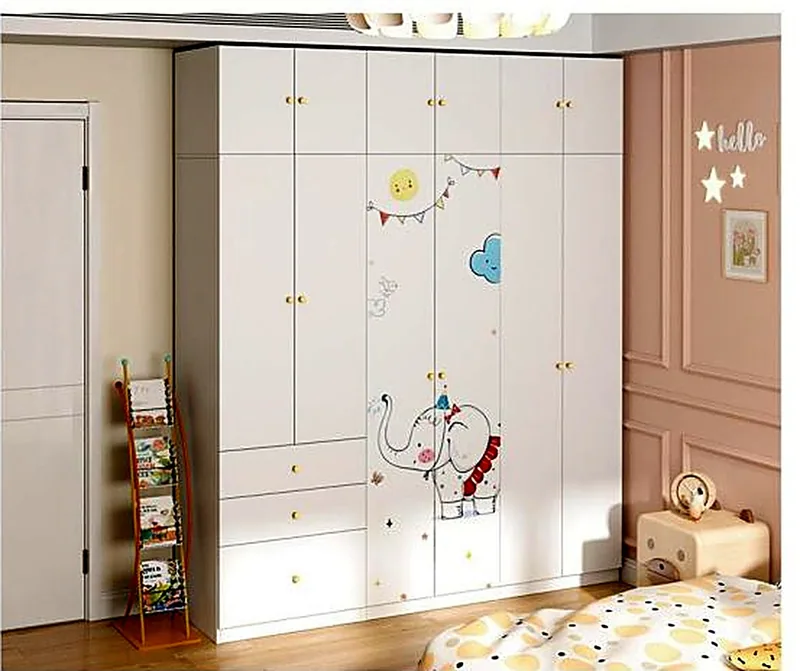
Three features of the listed product raise questions that a plain adult wardrobe would not: printed elephant artwork on the doors, gold knobs and drawer units that a child can reach, and the fact that it is a children's product. Each connects to a rule area below.
Rules that apply to a children's wardrobe in Canada
- Canada Consumer Product Safety Act (CCPSA). It prohibits consumer products that are a danger to human health or safety, requires incident reporting and allows recalls. Health Canada enforces it.
- Surface Coating Materials Regulations. Paints and coatings on furniture and on children's products are limited for lead (90 mg/kg) and for mercury. Printed artwork, lacquer and the gold finish on knobs are all coatings in this sense.
- Consumer Products Containing Lead Regulations. These set lead limits and include products for young children.
- Phthalate limits. They apply to soft vinyl in childcare articles and toys. If any part of the version you order is soft vinyl, ask for the test report.
- Formaldehyde emissions from composite wood. If the body uses plywood, particleboard, MDF or laminated panels, the product must meet emission limits, be certified by an approved third-party certifier and be labelled. Ask for the TSCA Title VI or Canadian compliance certificate; they are aligned.
- Consumer Packaging and Labelling Act. Prepackaged consumer products need bilingual product identity and net quantity plus the dealer's name and place of business.
Rules change and this is not legal advice. Confirm current requirements with Health Canada, your inspector or your customs broker.
Document checklist for TVD-6412
| Document | Why you want it | Who issues it |
|---|---|---|
| Coating or print test report (lead, mercury) | Shows the elephant print, lacquer and knob finish respect the coating limits | Accredited testing laboratory, supplied through the factory |
| Composite wood certificate (if board is used) | Proves the panels meet formaldehyde limits and are labelled | Approved third-party certifier |
| Children's product lead test | Covers the lead rules for products for young children | Testing laboratory |
| Phthalate report (only if soft vinyl is present) | Required where soft vinyl appears in childcare articles | Testing laboratory |
| Material declaration for knobs and hardware | Lets you see what the gold finish and fixings are made of | Factory, confirmed by us on the quote |
| Bilingual packaging and label proof | Needed to sell the product prepackaged in Canada | Dealer or importer, we help with the content |
| French instructions and warranty text | Retailers in Quebec will ask for it | Factory or importer |
CE mark versus Canadian requirements
Canada does not recognise the European CE mark as proof of compliance for consumer products. A wardrobe that arrives with CE paperwork still needs the Canadian points above. For this model nothing in the listed features is powered, so a Canadian electrical mark such as CSA, cUL or cETL would not apply; if a lit or plug-in version ever appears, our guide to the CSA, cUL and cETL marks explains what to ask for.
Provincial differences
The federal rules apply everywhere. The main difference between provinces is language: in Quebec the Charter of the French language requires labels, instructions, manuals and warranty documents to be available in French, with French at least as prominent as any other language. Quebec repealed its stuffing permit and label rule on 9 December 2021; for this wardrobe, padded or stuffed parts would raise only a fibre-content labelling question, and the quote will state that. Check current rules in your own province before you place the order.
What happens if the paperwork is missing
- A retailer or buying group can refuse to list the product until test reports are produced.
- A shipment that cannot show where it stands on children's product rules can be held while questions are answered.
- If a product on the market turns out to be unsafe, the CCPSA allows Health Canada to order a recall, and the importer carries the cost and the reputation damage.
How we handle it
When you request a quote through our quote form, we ask the factory for the coating, composite wood and lead reports that apply to the version you intend to buy, and we state in the quote what is available and what is not. If a report is missing we say so, and you decide whether to proceed, order a sample for independent testing or choose a different model from the wardrobes and display cabinets line. Duties and taxes follow the HS classification and origin; our customs broker confirms classification before a delivered cost is quoted, and the sales tax guide explains the provincial part. Our ordering page covers deposit (30%) and release (70%) terms.