Certification guide ·
Metal-Frame Leather Loveseat (TVD-4418): Faux Leather, Coatings and Label Rules for Canada
A faux leather covering and a painted metal frame raise their own questions in Canada: classification, coatings, labels and tender tests. Here are the answers.
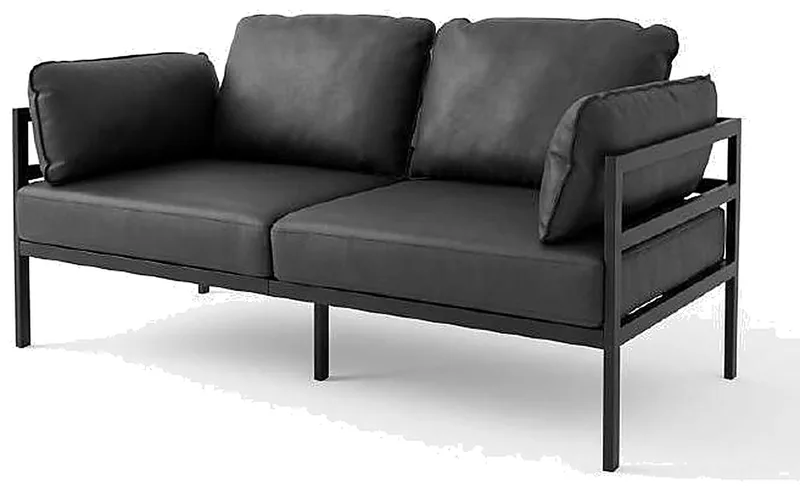
The Metal-Frame Leather Loveseat (TVD-4418) is described with black faux leather cushions on a slim black metal frame, in a two-seat size. Faux coverings and painted metal frames raise a different set of questions from a classic hide-covered sofa. Is the covering leather for customs purposes? What finish is on the frame? Who needs which label? This page answers those questions for a buyer in Canada. The buying guide for the loveseat covers sizing, use and ordering.
To be clear about status: we have no certification document on file for this loveseat. We confirm certification status and supply the documents with the quote before you order.
Question one: does faux leather count as leather at the border?
Certain upholstered domestic seating from China is subject to anti-dumping and countervailing duty when it is leather or has a motion or reclining mechanism. Fabric-only stationary seating is excluded. The duty is very high, often more than the value of the goods. Our listing describes the cushions as faux leather and the loveseat has no mechanism, so on its face it is a stationary seat with a synthetic covering. Customs classification depends on the exact construction and the material, not on the product name, so our customs broker confirms the tariff classification and the origin before we quote a delivered cost. If any part of the covering is genuine leather, say so now. Where duty would apply, we may source from another origin.
Question two: what is on the metal frame?
A slim black metal frame is almost certainly painted or powder coated. The Surface Coating Materials Regulations set limits on lead and mercury in paints and coatings on furniture. If the loveseat is sold for use by children or in a childcare setting, the limits and the lead rules for children's products tighten the picture further. Ask the factory for a coating test report that covers the black finish. If the frame includes any wood or board component, the formaldehyde rules for composite wood also apply to that part.
Question three: cushions, covering and labels
Cushions used to be caught by provincial stuffing permits, but Quebec repealed its regulation in December 2021 and Ontario repealed its own in 2019, so no permit number or law label is needed. If the covering or the cushions are sold as consumer textile articles, the Textile Labelling Act expects fibre-content and dealer identity labelling. For a synthetic covering the fibre content statement may be unusual, so we confirm with the quote how the label should read for this model.
Question four: flammability and soft vinyl
Contract buyers such as hotels, offices and restaurants frequently write a flammability test into the tender, for example California TB117-2013 or another standard the tender names. Synthetic coverings can perform differently from fabric in those tests, so ask for the report for the exact covering. If the loveseat will be used in a children's setting, remember that phthalate limits apply to soft vinyl in childcare articles and toys. For ordinary adult lounge use that rule is not engaged, but it is better to ask the factory now than to explain later.
Document checklist for the Metal-Frame Leather Loveseat
| Document | Why you need it | Who issues it |
|---|---|---|
| Covering material statement and customs classification | Decides whether the leather and motion duty could apply | Factory data reviewed by our customs broker |
| Coating test report for the black frame finish | Furniture coatings have lead and mercury limits | A test laboratory, via the factory |
| Flammability report for the covering and cushion filling | Tenders often name a flammability test | An accredited test laboratory |
| French-language label artwork | Quebec buyers expect French labels on cushions and upholstered articles | The seller or importer |
| Fibre-content and dealer label text (if sold as a textile article) | The Textile Labelling Act expects it | Importer or seller, with factory data |
| French manual and warranty text | Quebec rules on language | Factory or our team on request |
CE marking and Canadian marks
This loveseat has no powered part in its listed features, so no electrical mark is needed unless a version you order adds one. Even so, Canada does not recognise the CE mark as proof of compliance for consumer products. If a variant adds a charging port or lighting, it must carry a Canadian electrical mark such as CSA, cUL or cETL; see our CSA, cUL and cETL marks explainer.
Provincial differences
- Quebec: French labels, manuals and warranty text; the old stuffing permit was repealed in 2021.
- Ontario: the old stuffing rule was repealed in 2019; tender requirements and the Consumer Packaging and Labelling Act still apply to prepackaged goods.
- Elsewhere: check with the provincial authority or your inspector for anything beyond the federal rules.
What happens if something is missing
A Quebec retailer will not list an upholstered loveseat without the label. A tender can reject a delivery without the flammability report. A customs assessment can arrive after landing if the classification was not settled in advance. Under the Canada Consumer Product Safety Act, Health Canada can recall a product that is a danger to health or safety, and it requires incident reporting.
How we handle it
When you request a written quote, mention the delivery province, the setting (café, office, hotel, retail) and any tender wording. We confirm certification status, the duty position and the documents in writing next to price, packing, lead time and delivered cost. Payment is 30% deposit and 70% before release; the how ordering works page has the steps. For the group, see the Sofas, Sectionals & Armchairs page. This page is general information, not legal advice. Rules change, so confirm with the authority, your inspector or your customs broker.