Certification guide ·
Auditorium Seating: Certification and Compliance Checklist for Canada
Fixed seating is judged on layout, fabric and coatings, and on what your tender or fire official asks for. Here is the paperwork to collect before you order.
Auditorium seating is regulated by the room, not only the chair
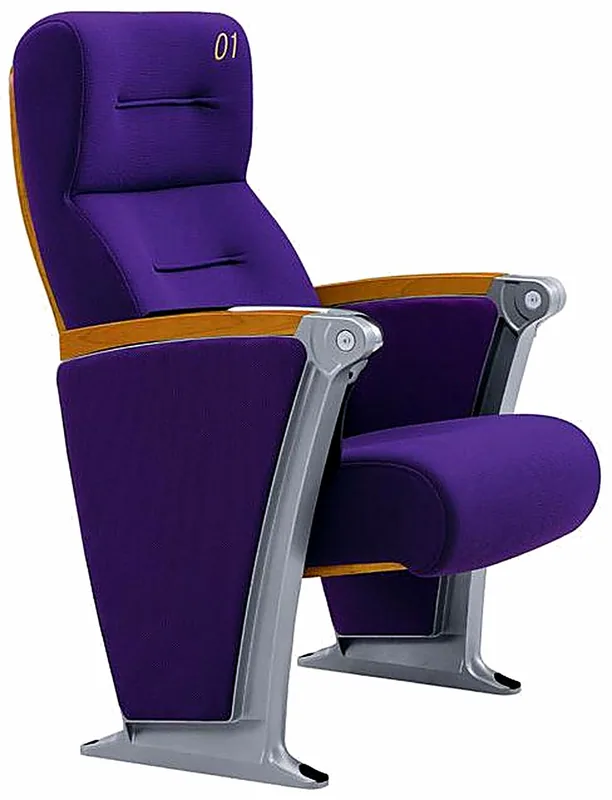
Buyers who type auditorium seating certification into a search box expect a single stamp. In Canada there is no one mark for fixed seating. Instead, several separate checks apply: the building and fire codes that govern the room, the product rules that govern the seat, and whatever your tender specifies. This guide uses the Auditorium Seat, Contoured Fabric (TVD-4244), an upholstered high-back seat with a wooden armrest, cast metal legs and a fold-up seat for easy passage, to show the checklist. It belongs to our auditorium and lecture seating line.
No certification mark or test report is on file for TVD-4244 today. If your tender names a flammability test, we request the matching report from the factory before you order and state what exists on the written quote.Rules that sit on the room
Auditoriums, theatres and similar spaces are assembly occupancies. The provincial building and fire codes govern fixed seating layout, aisle widths and anchoring, and the authority checks them. We do not give dimensions or code citations here. Your designer or fire official confirms the requirements for your room, and we then confirm that the seat spacing and floor fixing we quote match what they asked for.
That is why our buying note for this line asks for a room drawing with row lengths and floor slope. Seat spacing is set centre to centre, and the fixing method must suit your floor. Confirm those with the authority before the order is placed, not afterwards.
Product rules that apply to the seat itself
- Canada Consumer Product Safety Act. It applies to consumer products and prohibits those that are a danger to human health or safety. Where seating is sold to consumers it matters most, but institutional buyers still expect the supplier to treat safety seriously.
- Surface Coating Materials Regulations. They set limits on lead (90 mg/kg) and on mercury in coatings and paints used on furniture. Ask for a coating report covering metal parts and any painted or stained wood.
- Composite wood formaldehyde rules. Since 2023, hardwood plywood, particleboard, MDF and laminated products must meet formaldehyde emission limits, be certified by an approved third-party certifier and be labelled. If the armrests or panels on a seat use these materials, ask for the TSCA Title VI or Canadian compliance certificate.
- Flammability reports. Contract buyers such as theatres, schools and churches often specify upholstery flammability test reports, for example California TB117-2013 or the standard named in the tender. These are buyer specifications, not federal law, so confirm what your tender requires.
- Fibre-content labelling for the seat. Older guides still describe a Quebec permit number and label for padded and upholstered goods, but that law was repealed in December 2021 and no province requires a stuffing permit today; fibre-content and dealer labelling under the Textile Labelling Act is what applies. We confirm how this applies to your order.
Document checklist
| Document | Why you want it | Who issues it |
|---|---|---|
| Upholstery flammability test report | Meets the standard named in your tender or by the fire official | Factory or accredited laboratory |
| Coating test report (lead and mercury) | Surface Coating Materials Regulations | Laboratory, via the factory |
| Composite wood formaldehyde certificate | Needed where panels use hardwood plywood, particleboard, MDF or laminate | Approved third-party certifier |
| Row layout drawing with spacing and fixing method | Lets the authority check aisles, anchoring and sight lines | Your designer, matched by our written quote |
| Fabric and foam description | Needed to match tender specification and Quebec labelling | Factory, on the written quote |
| French labels and care or installation instructions | Charter of the French language for sale in Quebec | Factory and you |
| Customs classification confirmation | Duty and delivered cost | Our customs broker |
Trade remedies on seating
Canadian anti-dumping and countervailing duties apply to certain upholstered domestic seating from China, in particular leather or motion and reclining types, while fabric-only stationary seating is excluded. Where a fixed seat with a fold-up mechanism sits in those rules is a question for classification, not for guesswork. Our customs broker confirms before we quote a delivered cost, and if a duty issue arises we may source from another origin. Rates and the list of goods change, so we never print them.
Differences between provinces
Quebec. French on labels, instructions, manuals and warranty documents, and fibre-content labelling under the Textile Labelling Act on upholstered articles. Retailers and public buyers in Quebec will ask. Ontario and elsewhere. Ontario repealed its similar upholstered rule in 2019. Other provinces differ, so check current rules. All provinces. Building and fire codes are adopted with changes by each province, with Quebec, Ontario, BC and Alberta having their own codes. A seat layout that one fire official accepts may need a change for another.What happens if a document is missing
A fire official can ask for flammability evidence at inspection. A school board can refuse delivery of seating that does not match the tender. A Quebec project can be held up without French-language labels and documents. Replacing seats after installation is more costly than asking for the reports first.
How we handle compliance
Every order starts with a written quote that states the specification, the certification status and documents, packing, lead time and delivered cost to your address. For TVD-4244 we confirm the fabric, the flammability reports your tender requires, the tablet and floor-fixing details, and any French labelling for Quebec. Samples are available on most items with the cost usually credited to the first order, and payment is 30% deposit and 70% before release (see how ordering works). Our guide to CSA, cUL and cETL marks explains why those marks matter for powered equipment but not for a seat.
For the buyer's view of this seat, including how it compares with the tablet and wing-back models, read the wholesale buying guide to TVD-4244. This is general information, not legal advice: confirm current rules with your provincial authority, fire official, designer and customs broker.