Product guide ·
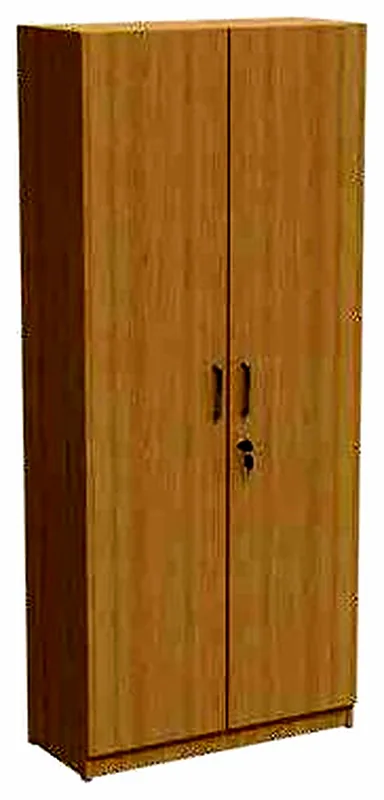
Tall Storage Cabinet – Wood (TVD-9317): double doors, adjustable shelves and a lock
Not everything in a children's space should be within a child's reach. The Tall Storage Cabinet – Wood is the closed, lockable piece in the kindergarten line. Here is how to specify and use it.
The one closed cabinet in the line
Most kindergarten storage is open so children can help themselves. The Tall Storage Cabinet – Wood (TVD-9317) is the opposite: a double-door cabinet with adjustable shelves that is lockable. It is where adult things go. Art supplies that need supervision, spare paper and glue, first-aid kits, teaching resources, enrolment files, staff bags and cleaning supplies are all better behind a locked door.
Its typical buyers are daycares and schools, usually for staff rooms, supply closets and the back of a classroom. Offices of small early-learning centres use it as a general cabinet, since a tall wooden cabinet with adjustable shelves has uses well beyond kindergartens. The listed features are short, so most of what you need to know is confirmed on the written quote, but each feature has practical consequences.
What the listed features mean in practice
- Double-door cabinet. Two doors give access to the whole interior and are easier to open in a narrow room than a single wide door. Ask how far the doors open, what hinges are used and whether they have any soft-close or finger-protection feature. In a children's space, finger-pinch points at hinges are a genuine concern.
- Adjustable shelves. Shelf positions can be changed to suit tall boxes or short ones. Ask how many shelves come with the cabinet, how many height positions there are, what holds the shelf (pins, clips, slots) and the rated load per shelf.
- Lockable. A lock keeps children out and keeps supplies in. Ask what lock type is fitted, how many keys come with each cabinet and whether units can be keyed alike for a building. Keyed-alike locks are convenient for a school that wants one key for every supply cabinet; confirm availability on the quote.
A tall cabinet in a children's room: stability first
Tall furniture is the piece most likely to cause harm in a room full of children. The cabinet should be anchored to the wall, and the quote should say what anchoring hardware comes with it. Check the base footprint against the height, and check that loading the top shelf with heavy items cannot tip the unit. Put heavy items on lower shelves. Open both doors at once only if the unit is anchored. Ask also whether the doors are stopped in the open position so they cannot swing back onto a child.
How to specify it: a checklist
- Overall height, width and depth in metric and imperial, and ceiling clearance, including any lights or sprinklers near the ceiling.
- Door swing and clearance in front of the cabinet.
- Shelf count, shelf spacing options and rated load per shelf.
- Lock type, number of keys and whether keyed-alike is possible.
- Panel material, thickness, edge finish and back panel construction.
- Anchoring hardware supplied and wall types it suits.
- Assembly level, hardware, carton size and units per container. A tall cabinet in a flat-pack carton is long and heavy, so plan the route into the building.
Where it sits in the line
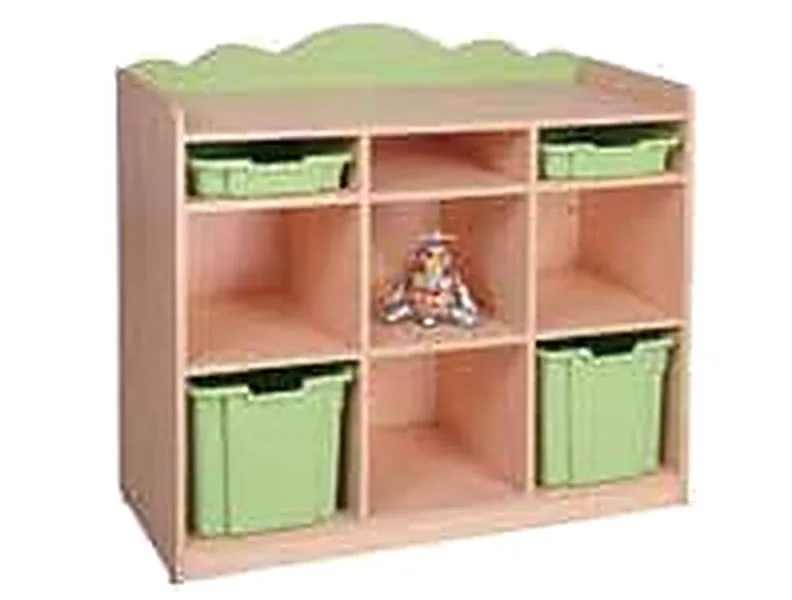
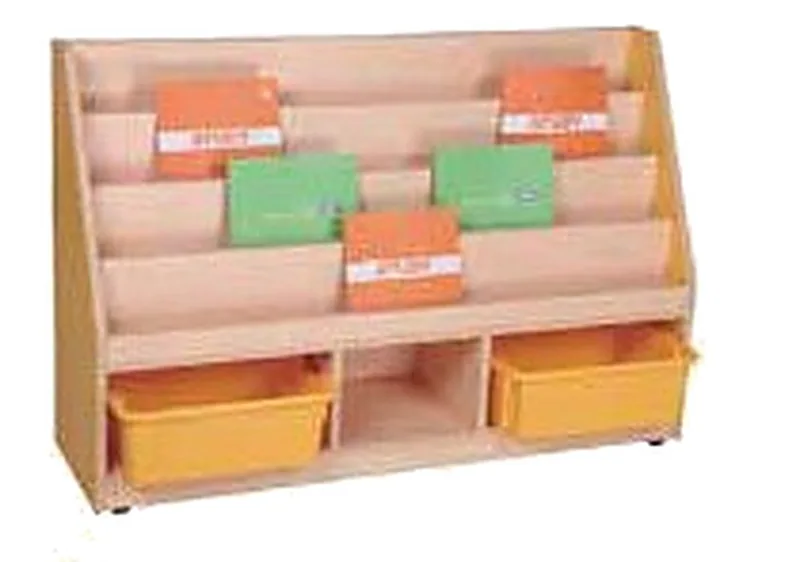
Pair it with the open pieces. A typical room plan has the Kindergarten Storage Cabinet (TVD-9311) or Classroom Cubby Shelf – Wood (TVD-9315) at child height for belongings, the Kids Book Display Shelf (TVD-9312) in the reading corner, and one tall locked cabinet for the adults. If you are choosing between a closed and an open unit, our guides to the storage cabinet and the book display shelf describe how the open ones work. For a wood table and chair to match the tone, the solid wood table and chair guide is the place to start.
Canadian use notes
A locked cabinet against an exterior wall in an unheated storage room will see temperature swings; paint, glue and some cleaning products stored inside can freeze in a Canadian winter, so store liquids in a heated room. Dry heated air on the Prairies and in central Canada can shrink doors slightly so that they stop lining up; check hinge adjustment after the first heating season. Coastal and Atlantic humidity can swell them. Freight moves by sea to Vancouver or Prince Rupert and then rail and truck; open cartons on delivery to check doors and lock for damage.
Rules that touch this cabinet come from its wood panels and its use in a children's space. Composite wood panels (particleboard, MDF, hardwood plywood, laminated products) must meet formaldehyde emission limits, be certified by an approved third-party certifier and be labelled. Any paint or coating on a children's product is limited to 90 mg/kg of lead, with a mercury limit as well. We hold no certification mark for TVD-9317, so we do not call it certified; we confirm what documents exist and supply them with the quote before you order. Rules change. Ask your licensing officer or school board about their requirements. The kindergarten furniture rules guide has the full list.
How ordering works
Request a written quote on the quote page with quantity and delivery address. It shows price for the quantity, specification, certification status and documents, packing, lead time and delivered cost. Many lines have low trial quantities and samples are on offer for most items, with the sample cost usually credited to the first order; a sample cabinet lets you try the lock and doors in person. Payment is 30% deposit and 70% before release. Cabinets, tables and chairs from different factories can share one container. More on how ordering works, sales tax by province and the kindergarten furniture line. A free account shows the full specifications on the product page.