Certification guide ·
Holiday Rectangular Tray (TVD-10317): Labels, Print and Food-Contact Paperwork
A practical compliance guide for retailers and caterers stocking a printed holiday rectangular tray, with the document list we confirm on every quote.
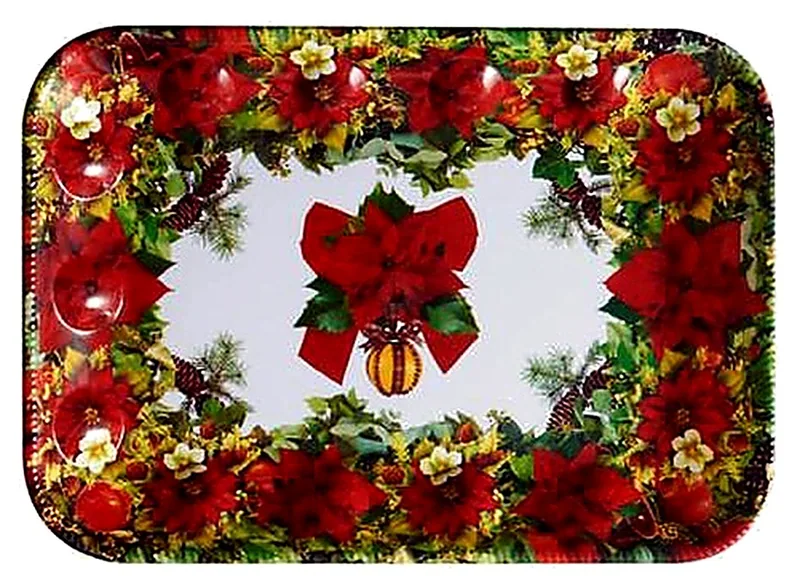
A rectangular tray earns its keep on buffets, in coffee service and on retail shelves around the holidays. The Holiday Rectangular Tray (TVD-10317) comes with holiday and fruit prints, and the same product description shows kids character round trays and round, square and rectangular formats. This guide looks at it from the angle of a business that will label, stock and serve from it: what to request, what Canadian packaging and language rules mean, and where we stand today.
What we have on file
No certification mark is on file for TVD-10317, and no test report has been supplied to us at this stage. We confirm certification status and send the documents with the quote before you order. If a document does not exist, you will see that on the quote.
Rules that follow a rectangular serving tray into a shop or kitchen
- Food and Drugs Act: sellers may not sell food in or with materials that may make it harmful. Health Canada does not pre-approve kitchenware, so retailers and caterers typically ask for food-contact test reports from the factory.
- Consumer Packaging and Labelling Act: if the tray is sold prepackaged to consumers, the pack needs bilingual (English and French) product identity and net quantity, and the dealer's name and place of business.
- Quebec: under the Charter of the French language, labels, instructions and warranty documents must be available in French, with French at least as prominent as other languages.
- Canada Consumer Product Safety Act: applies to consumer products and prohibits those that are a danger to human health or safety; it also requires incident reporting and allows recalls.
- Lead rules: Canada's limits on lead in consumer products include kitchen utensils, and the Glazed Ceramics and Glassware Regulations apply if a version is glazed ceramic or glass. Ask for test results covering the printed areas.
Rules change, so confirm with the authority, your health unit or your customs broker. This is not legal advice.
Printed surfaces on a flat tray
A rectangular tray shows its decoration across a large flat area, which makes print durability visible. Ask whether the print is protected by a surface layer, how it behaves under repeated wiping or washing, and whether the factory states any dishwasher, oven or microwave rating. Nothing in our listing states one, so do not assume. Holiday prints are for a short season: approve artwork and colours before production, and confirm that the version you approve is the version in the sample and the carton.
Document table
| Document | Why it matters | Who issues it |
|---|---|---|
| Food-contact test report | Typically requested by retailers, caterers and inspectors for serveware | Test laboratory, through the factory |
| Lead test covering printed areas | Printed holiday artwork is the main area of concern | Test laboratory, through the factory |
| Written material and size statement | Our listing gives shape and print only; sizes and material are confirmed on the quote | Factory, via our quote |
| Carton and label specification | Bilingual identity, net quantity, dealer name, barcode, French for Quebec | Us, with your retailer |
| Heat and washing statement | Decides whether the tray can go in a commercial dishwasher or warm service | Factory, in writing |
| Certification status note | Plain statement that no mark is on file and what we supply instead | Thames Valley Distribution |
If paperwork is missing
Large retail buyers can refuse to list a tray without food-contact evidence, and a Quebec store may refuse stock without French labelling. A recall or an incident report under the Canada Consumer Product Safety Act is a far bigger cost than the report would have been. The practical lesson for seasonal stock: ask early, because testing and label revisions take time that a holiday deadline does not allow.
How we help
We request reports from the factory, check them against the version you are buying, and place the answers on the written quote together with quantity, packing, lead time and delivered cost. Samples are available on most items and the sample cost is usually credited to the first order. A CE mark does not stand in for any of this, since Canada does not recognise it as proof of compliance for consumer products.
Seasonal planning for a flat tray
Holiday stock sells inside a short window, so work backwards from your shelf date. Allow time for samples, artwork sign-off, any extra testing and label proofs, then for production and freight. A rectangular tray is also easy to stack, which helps carton planning, but ask for carton quantity and size on the quote and ask how trays are separated so prints do not scuff each other in transit. If you sell some trays loose and some in sets, say so at quote stage so packing and labels match each channel.
Related pages
The oval version has its own certification guide for TVD-10316, and both trays share the print family covered in the holiday round tray guide. For a floral alternative, read about the gold-rim floral glass platter. You can browse the product line page and read the wholesale guide for sourcing.
Delivery planning starts with the Canada delivery hub, and the sales tax guide explains how provincial tax applies. Read how ordering works and use the quote request to start; payment is 30% deposit and 70% before release.