Product guide ·
Open Multi-Deck Display Chiller (TVD-10825): Wholesale Guide for Canadian Grab-and-Go Counters
An open-front chiller is a merchandising tool first and a refrigerator second, so the room it sits in matters as much as the cabinet. Here is how to specify TVD-10825 and order it for Canada.
What it is and who buys it
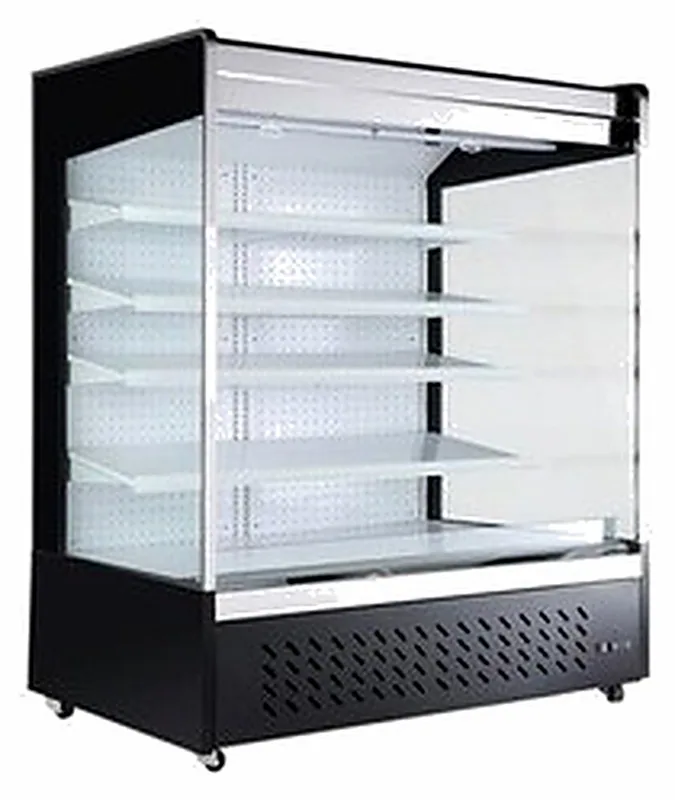
The Open Multi-Deck Display Chiller (TVD-10825) is a tiered, open-air chilled display with LED lighting, designed for beverages and grab-and-go food in cafés. Unlike a cabinet with a door, an open chiller lets customers reach straight into the product, which is why it turns up in coffee shops, bakery counters, hotel breakfast bars, convenience corners, and hospital or campus food courts. The buyer usually has a tight sales floor and wants several shelves of product visible at eye level, in a footprint that stays small.
Reading the listed points in practice
- Open-air display: with no door, the cabinet relies on its own airflow to keep chilled product cold at the front. Draughts from an entrance, a ceiling vent or a fan can disturb that airflow, so placement is part of the specification.
- Multi-deck: several shelves mean more product on view, but loading discipline matters. Packages blocking the air path at the back or the shelf edge reduce performance, and staff need a simple fill-line routine.
- LED lighting: the lighting helps product colour and packaging stand out. Ask whether the strips are on a separate switch so that staff can dim the cabinet overnight.
- Cafés and grab-and-go: the unit is meant for product that turns over quickly. Use it for sandwiches, drinks, yoghurt cups and similar packaged lines, not for long storage of bulk food.
How to specify it
Treat this as an air-and-room problem and ask the questions below on the written quote:
- Electrical supply. Confirm voltage, phase, frequency and amperage, plus whether it is cord-and-plug or hard-wired. Larger open chillers can draw more than a small cabinet, so check the circuit with your electrician.
- Refrigerant type and temperature range. Ask what temperature range the unit holds and what ambient room conditions that range assumes.
- Remote or self-contained compressor. Ask where the heat goes. A self-contained unit puts warm air into your room.
- Night cover or blind. If an overnight cover is available, ask for it in the quote.
- Drain and condensate. Open cabinets pull moisture out of the air, so confirm how condensate is evaporated or drained.
- Shelf adjustability and load. Ask how many decks, how deep they are and what each one holds.
- Overall and crated dimensions and weight, so you can plan the door, the lift and the footprint.
- Certification status. No mark is on file for TVD-10825, so we confirm what applies and send documents with the quote before you order.
How it compares within the line
Within our commercial kitchen equipment line, the open chiller is the more ambitious cousin of a small closed showcase. If you only need a handful of drinks at the till, a compact unit may be enough. If you are building a self-serve wall, a multi-deck design shows more. Cooking equipment sits in a different category altogether. The Chinese Wok Range, Two Burner (TVD-598) and the Gas Boiling Range, Single Burner (TVD-10813) are gas appliances with ventilation and gas fitting requirements, while the Tilting Kettle & Braising Pan (TVD-597) suits large-batch institutional kitchens. A chiller has none of those requirements, but it does share the same electrical-mark and health-unit questions.
Canadian use notes
- Heated winter interiors. Dry, warm rooms in winter and hot patio-door days in summer both change the load. An open cabinet is more sensitive to room conditions than a closed one, so tell us the typical indoor range.
- Entrances and vestibules. Cold gusts and floor heaters near a front door disturb the airflow. Place the unit away from them.
- Voltage. Canada runs on 120 V or 240 V single-phase, and 208 V or 600 V three-phase, at 60 Hz. Equipment rated 220 V and 50 Hz must be confirmed as built for Canadian supply before ordering.
- Freight in winter. Electronics and liquids can freeze in transit. Tell us the delivery month and we will plan packing and unpacking steps.
- Quebec. Manuals, labels and warranty papers should be available in French.
- Health unit. Check whether yours or your landlord expects NSF/ANSI or an equivalent sanitation mark on a display unit.
Our guide to CSA, cUL and cETL marks explains which electrical marks Canadian inspectors accept.
How ordering works
Submit a quote request with the quantity, delivery address and a note on the room. The written quote covers price for your quantity, specifications, certification status and documents, packing, lead time and delivered cost. Trial minimums are low on many lines and samples are available on most items, with the sample cost usually credited to the first order. Payment is 30% deposit and 70% before release. Several factories can share a consolidated container, so a chiller can ship with other fit-out goods. The ordering page explains each stage and the sales tax by province guide covers GST, HST, PST and QST. For a planning figure, try the landed cost calculator; our customs broker confirms duty before we quote a delivered cost.
A free account on the site shows full product specifications. For the wider range of equipment we supply, read the commercial kitchen equipment wholesale guide.