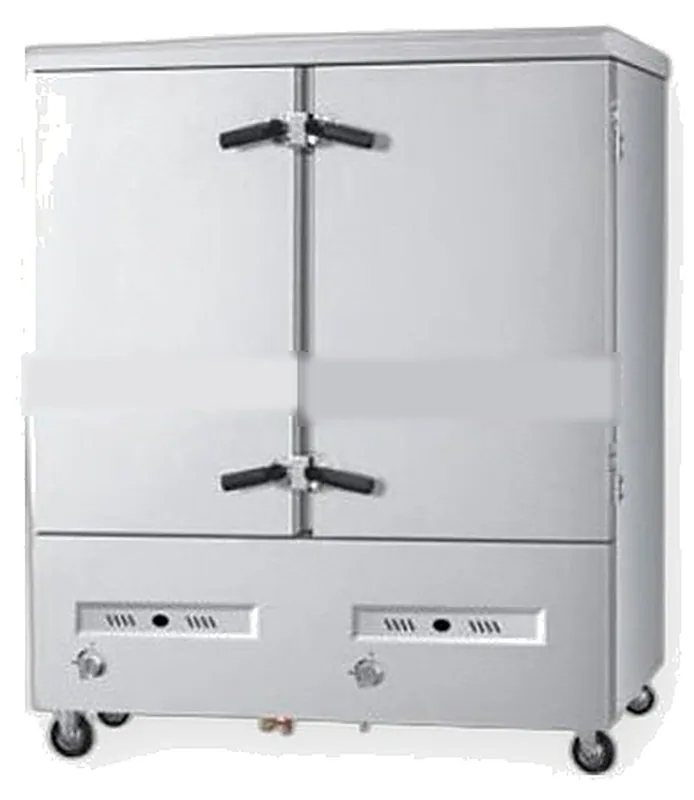
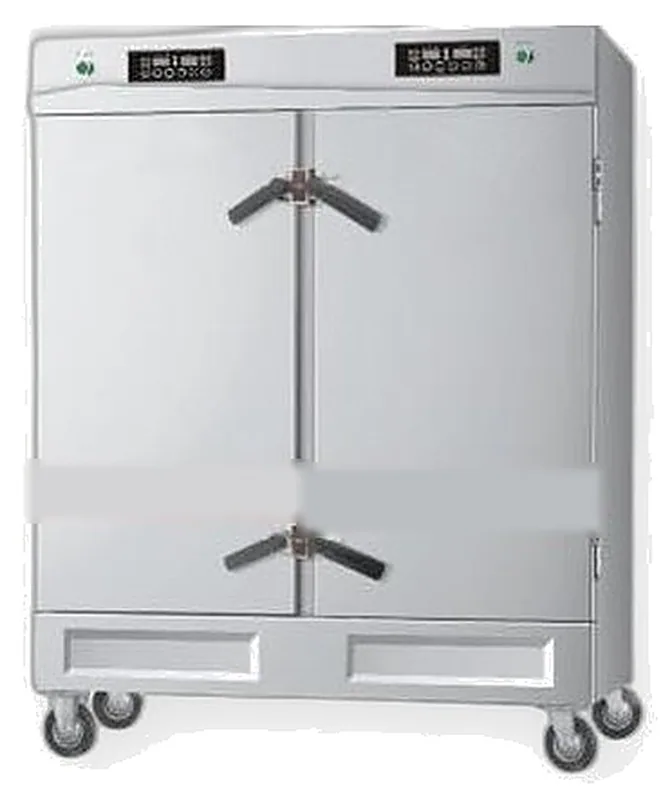
Product guide ·
Two-Door Steam Cabinets (TVD-599 and TVD-10814): Which One for Your Kitchen?
Two steam cabinets share one listing profile: multi-tray, gas or electric, large volume. Here is how to tell them apart on the quote and how to buy them for Canadian kitchens.
When a kitchen steams in volume, whether buns, vegetables, rice or portioned proteins, a pot with a lid is not enough. Two products in our commercial kitchen line fill that gap: the Steam Cabinet, Two Door (TVD-599) and the Steam Cabinet, Two Door, Digital (TVD-10814). Both are listed as "multi-tray steam cabinet", "gas or electric" and "large volume". Capacity, rating and dimensions arrive on your written quote, and a free account shows full specifications on the product pages.
What the two have in common
- A two-door cabinet. Each side is loaded separately, so a crew can open one door while the other compartment keeps steaming.
- Multi-tray loading. Food goes in on trays or racks, so a full cabinet turns out many portions at once.
- Gas or electric. Both products are offered in either energy source. The choice depends on what your kitchen has, not on preference alone.
- Large volume. Both are meant for production kitchens rather than a single steamer basket on a stove.
How they differ
| Point | TVD-599 | TVD-10814 |
|---|---|---|
| Name | Steam Cabinet, Two Door | Steam Cabinet, Two Door, Digital |
| Listing listed points | Multi-tray steam cabinet; gas or electric; large volume | Same three listed points |
| What the name suggests | The standard version | A digital version; we confirm what the digital control adds on the quote |
| Best matched to | Crews that want a simple, familiar control | Kitchens that want to set and repeat cooking times on a display |
We say plainly that the listed points are identical. The difference we can state is the word "Digital" in the second name. Ask on the quote for the control type, timer functions, display language and what is adjustable. If your crew works in French, ask whether the display can be set that way.
Who buys which
The line sells to restaurants, hotels and institutions. A restaurant that steams dumplings or buns through every service, a hotel banquet kitchen with large vegetable and fish orders, and an institutional kitchen that portions food in trays will all find a use. The standard cabinet suits a crew that needs few settings. The digital version suits a multi-site operation that wants consistent timing from different cooks, because a displayed time is easier to train than a dial setting. Both are a sensible companion to a Chinese Wok Range, Two Burner (TVD-598) in an Asian-menu kitchen, where steaming and stir-frying run side by side.
Mixing both in one order
You can order both cabinets on one quote. A banquet kitchen might take one of each to compare crew reactions, or a group might standardise on one version for new openings and keep the other for existing sites. Because both come from the same product line, they can ship in the same consolidated container with other equipment, including the Combi Oven (TVD-596) or the Tilting Kettle & Braising Pan (TVD-597). Remember that a steam cabinet is a steamer only; a combi adds convection roasting, and the kettle handles liquids by the batch.
How to specify: the quote checklist
- Pick gas or electric and state your supply. For gas: the fuel (natural gas or propane), its input and the connection size. For electric: voltage, phase, frequency, amperage and plug or hard-wire.
- Steam source and water: inlet size, quality requirement and drain connection.
- Tray size and number of trays per door, with capacity in kilograms per batch if you cook by weight.
- Steel grade and thickness for cabinet and doors.
- Dimensions and weight; check door swing and clearance.
- The electrical, gas and sanitation marks each unit carries, and whether a field approval would be needed.
Canadian use notes
Ventilation. A steam cabinet releases hot vapour when the doors open. Plan the exhaust and the wall finish nearby with your designer and the local authority.
Gas or electric. A gas cabinet must be connected by a licensed gas fitter and should show a recognised gas food-service certification, with the regulator depending on the province. An electric cabinet is judged by its CSA, cUL or cETL type mark, or by its field evaluation label. A 220 V, 50 Hz rating on either cabinet needs written confirmation of Canadian suitability, because the grid here runs at 60 Hz.
Certification status. Neither unit has a certification mark on file. Certification details are written into the quote before you order. See CSA, cUL and cETL marks explained. Some health units and landlords also ask for NSF/ANSI sanitation certification, so tell us what yours wants.
Freight. Containers land at Vancouver or Prince Rupert and continue by rail and truck. Any water left in the steam circuit can freeze in winter transit, so state your delivery month.
How ordering works
Use the quote request and list both codes if you want both priced. Each answer is in writing: the price per quantity, the specification, certification position, packing details, lead time and delivered cost. Trial quantities are small on many lines and samples are usual, with the sample cost typically credited to the first order. Terms: 30% deposit, 70% before release. Read how ordering works, estimate duty and freight with the landed cost calculator, and check tax in the sales tax by province guide. For provincial context see our Ontario, British Columbia, Alberta and Nova Scotia guides, and browse the full equipment line.