Certification guide ·
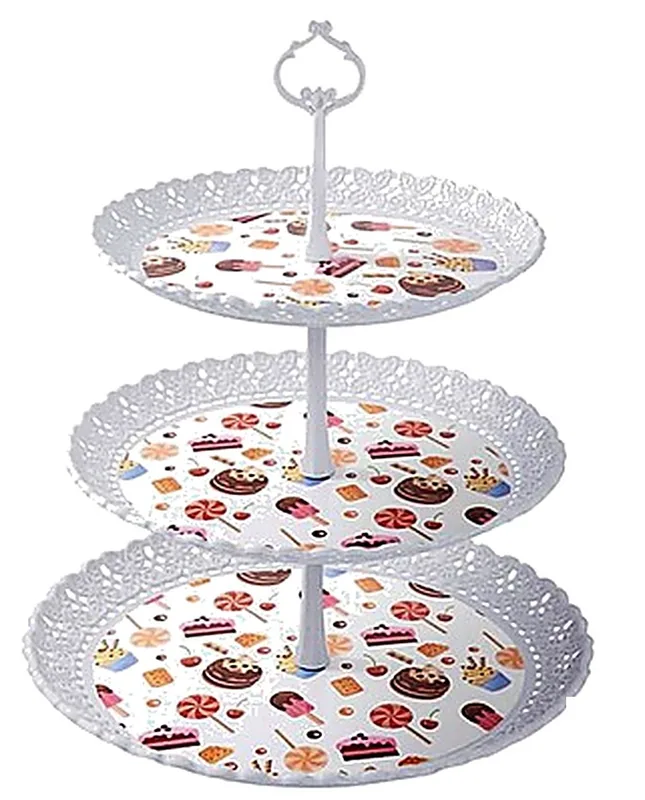
Three-Tier Cake Stand – Printed (TVD-10280): Canadian Certification and Compliance
No certification mark is on file for the printed three-tier stand, and none is claimed. What a Canadian buyer needs instead is a short, sensible file: food-contact evidence, a decoration test report, bilingual labelling if prepackaged, and a customs classification.
Where the printed three-tier stand stands today
The Three-Tier Cake Stand – Printed (TVD-10280) has handled floral baskets, tiered serving stands and a hollow-out decorative design. We hold no certification mark on file for it and we do not claim that it is certified, listed or approved. Before you order, we confirm certification status and supply the documents with the quote. This guide explains what those documents are and why a buyer asks for them.
The buying guide for the stand covers use and ordering; this page covers rules.
Which rules touch this product
Three areas apply to a decorated, tiered serving stand, depending on what it is made of and how it is used.
1. Food contact
The Food and Drugs Act prohibits selling food in or with materials that may make it harmful. Health Canada does not pre-approve kitchenware, though it offers voluntary Letters of No Objection for food packaging materials. In practice, buyers ask the factory for food-contact test reports (for example FDA or EU food-contact migration tests) covering the material, finish and any coating. The listed features do not say what the baskets are made of, so we confirm the material on the quote, and the report must match that material and finish.
2. Decoration, lead and cadmium
The product name says printed and the design is floral. For glazed ceramics and glassware that contact food, the Glazed Ceramics and Glassware Regulations under the Canada Consumer Product Safety Act set limits on lead and cadmium that can leach. Printed or metallic decoration near the lip is a known risk. If any decorated surface of the stand can touch food, ask for a lead and cadmium test report. The Consumer Products Containing Lead Regulations also include kitchen utensils. If the stand turns out to be a non-ceramic, non-glass material, the report asked for is the one that fits that material; we tell you which on the quote.
3. Electrical, only if a version has power
The listed features show no lights, motor or plug. If a version you order has a lit element with a mains plug, it must carry a certification mark from a certification body accredited by the Standards Council of Canada (CSA, cUL or cETL) or a field evaluation label. A US-only UL or ETL mark is not enough. Battery-only items follow general consumer product safety. Our guide to CSA, cUL and cETL marks explains how to read them.
Document checklist
| Document | Why it matters | Who issues it |
|---|---|---|
| Material and finish declaration | Tells the lab, the inspector and you what the surface is | Factory |
| Food-contact test report for the stand's material and coating | Evidence that the product is not made with materials that may harm food | Accredited lab, via the factory |
| Lead and cadmium test report for printed decoration | Answers the known risk on decorated items | Accredited lab, via the factory |
| Canadian electrical certification evidence (only if a version is powered) | Inspectors and insurers can refuse uncertified electrical goods | Accredited certification body |
| Draft bilingual label and carton marking | Prepackaged consumer products need bilingual text | You, with our wording check |
| Tariff classification and origin | Sets duty and delivered cost | Our customs broker |
CE and Canadian marks
Canada does not recognise the European CE mark as proof of compliance for electrical or consumer products. A CE-marked stand still needs the Canadian points above. For a non-powered serving stand there is generally no electrical mark to chase, but there are test reports, and a CE-style declaration is not a substitute for them.
Provincial and retailer differences
- Quebec. Product labels, instructions, manuals and warranty documents must be available in French under the Charter of the French language, with French at least as prominent. Quebec retailers will ask for it.
- Ontario, British Columbia and the other provinces. The differences are mainly in food premises rules, where provincial regulations and local public health inspectors expect cafés and caterers to use equipment that is durable, easy to clean and kept sanitary. Openwork can draw questions, so discuss cleaning with your health unit.
- Franchisors and landlords. Many ask for NSF or equivalent sanitation certification on commercial food equipment. Check what yours asks for; we do not claim any such certification for this stand.
What happens if documents are missing
A retailer's compliance team may refuse to list a decorated food-serving item without a lead and cadmium report. A health inspector can object to equipment that is hard to clean. If a decorated item sheds metal or coating into food, the Canada Consumer Product Safety Act allows incident reporting, recalls and prohibition of products that are a danger to health. Weak documents also make an insurer's life harder. Asking for the documents before you order costs far less than finding the gap afterwards.
How we handle it
We confirm certification status on the written quote and supply the documents with it, before you order. If a test report is missing we request it from the factory, or discuss another item. Orders follow our ordering process: 30% deposit, 70% before release, samples on most items with the cost usually credited to the first order. Compare other stands in the cake stands range and the decorated line compliance guide, or send your list to the quote page. Rules change; confirm with Health Canada, your inspector or your customs broker. This is not legal advice.