Product guide ·
Under-Counter Glass-Door Fridges for Line Stations: Choosing Between 4 Doors and 2
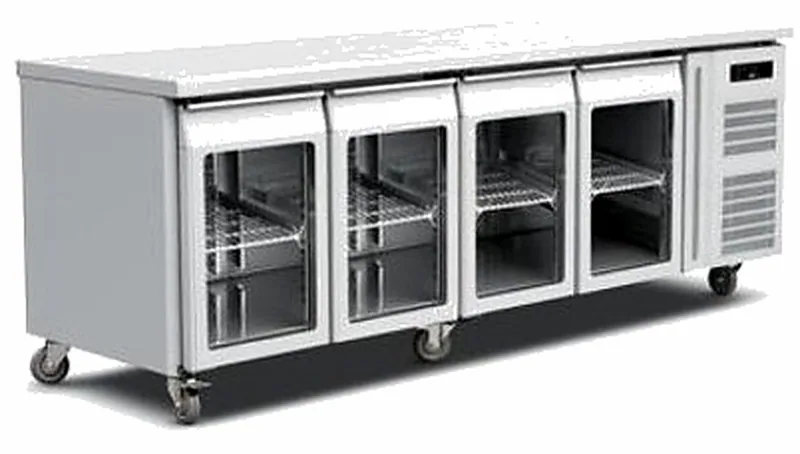
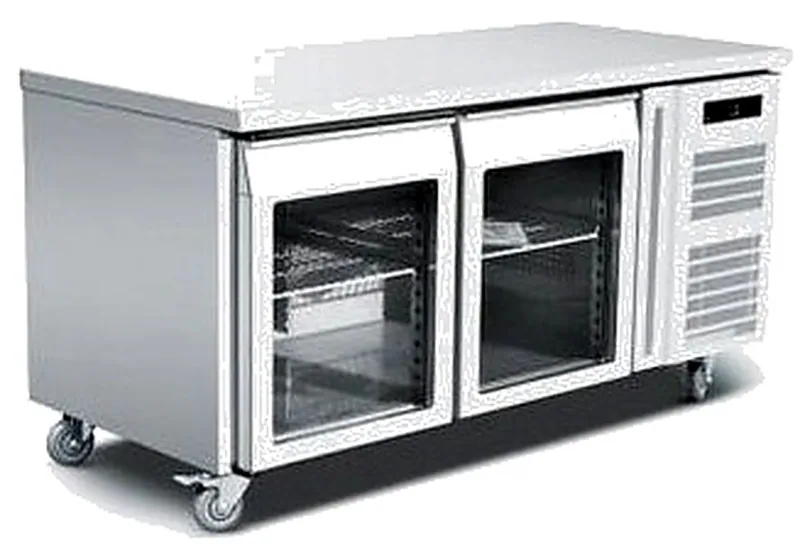
Two worktop fridges with glass doors, TVD-611 and TVD-10821. The difference is how many doors you need on the line, and what your power and drain plan can carry.
A fridge you can see into, built to sit under the pass
Line cooks open an under-counter fridge hundreds of times a shift, and a glass door lets them see stock without opening it. Both products here share the same listed points: prep and worktop fridges, glass or solid doors, and a fit for line stations. Under-Counter Fridge, 4 Glass Doors (TVD-611) is the wider unit for a long run of prep. Under-Counter Fridge, 2 Glass Doors (TVD-10821) is the shorter one for a single station, a bar corner or a small kitchen. Both belong to our commercial kitchen equipment line.
Neither has a certification mark on file at the moment. We state that plainly and confirm certification status and documents with each written quote.
What the two share
- Worktop height idea. Both are the under-counter kind, so the top can serve as a working surface; confirm the top material and any overhang on the quote.
- Glass doors. Both are listed with glass doors, and the line name notes that glass or solid doors exist; if you want solid, say so when you ask for the quote.
- Electrical and refrigerated. Both need a Canadian electrical mark route and refrigeration details: voltage, phase, frequency, amperage, refrigerant type, temperature range and ambient rating, all confirmed in writing.
- Food-contact interiors. Shelves, liners and gaskets touch food and containers, so sanitation certification and material documents come up for both.
How they differ
| Point | TVD-611, 4 glass doors | TVD-10821, 2 glass doors |
|---|---|---|
| Typical use | Long prep line, sandwich or pizza station, sushi counter | Single cook station, bar side, small café |
| Floor length needed | Longer run; measure the wall | Short; fits tighter bays |
| Doors opened per cook | More doors spread the traffic | Fewer doors, simpler handling |
| Electrical planning | Confirm the circuit for the larger unit | Confirm the circuit for the smaller unit |
| Capacity | Confirmed on quote | Confirmed on quote |
The listed points do not give capacity in litres, dimensions or weight, so those are confirmed on the written quote rather than estimated here.
Which buyer suits which unit
- Full-service restaurant with a long cold line: TVD-611 under the prep counter, keeping garnish and sauces within reach.
- Small café, juice bar or hotel breakfast station: TVD-10821 where floor length is the limit.
- Multi-site operator: a standard of one code at each station size keeps training, spare parts and cleaning routines consistent.
Layout questions to settle before you order
- Door swing against the walkway. Glass doors invite a quick look, but a door that opens into the cooks' path slows service; measure the aisle in front of the run.
- Top surface use. Because these are worktop units, ask what the top is made of and whether a cutting board or a rail for pans sits on it.
- Heat from neighbours. A grill or flat top to one side raises the air the fridge breathes; ask for the ambient rating and keep the clearance the factory states.
- Cleaning access. Glass shows smudges. Decide who wipes the doors, and with what, before the unit is installed.
Putting both on one order
Both codes can share a quote and a shipment. Give us the count of each, the width of every bay, and the position of the nearest outlet or electrical drop. Refrigerators arrive as boxed units, so the receiving rule is simple: do not plug in and load a fridge the moment it comes off a cold truck; ask the quote for the advice on resting time, which varies by refrigerant system. Consolidated shipping lets cold items travel with tables or cooking equipment from other factories, for example alongside a single-tank open fryer for a fry station on the same line.
Canadian use notes
- Voltage. Canadian supply is 120 V and 240 V single-phase, and 208 V or 600 V three-phase, at 60 Hz. Equipment rated for 220 V and 50 Hz must be confirmed as built for Canadian voltage and 60 Hz, since compressors and timers can misbehave on 60 Hz.
- Certification. Electrical equipment needs a mark from a Standards Council of Canada accredited body (CSA, cUL, cETL) or a field evaluation label. A US-only mark is not enough. Our marks explainer shows how to read them.
- Heat on the line. An under-counter fridge beside a range or fryer works in a hot space; ask for the ambient rating and refrigeration details on the quote.
- Energy rules. Commercial refrigerators can fall under Natural Resources Canada's Energy Efficiency Regulations; we check whether the category applies.
- Glass. Door glass is rarely a food-contact surface, but the glass and glazed-ceramics rules exist for items that touch food; we ask the factory and say what is on file.
How ordering works
Every order is quoted in writing for the quantity and address: price, specifications, certification status and documents, packing, lead time and delivered cost. Trial quantities are low on many lines, and samples are available on most items, with the sample cost usually credited to the first order. Payment is 30% deposit and 70% before release. Taxes follow the province of delivery; see the provincial tax guide for GST, HST, PST and QST. The ordering page walks through each step, and you can start a quote request with both codes. For delivery across the country, see our Canada hub and the category page for Canada.