Product guide ·
3 cm Exterior Tile PU Panel (TVD-1383) and 5 cm Exterior Tile PU Panel (TVD-1384)
Same face size, two thicknesses: 30 mm and 50 mm. Here is how depth changes the look, the handling and the questions you must ask for Canadian weather.
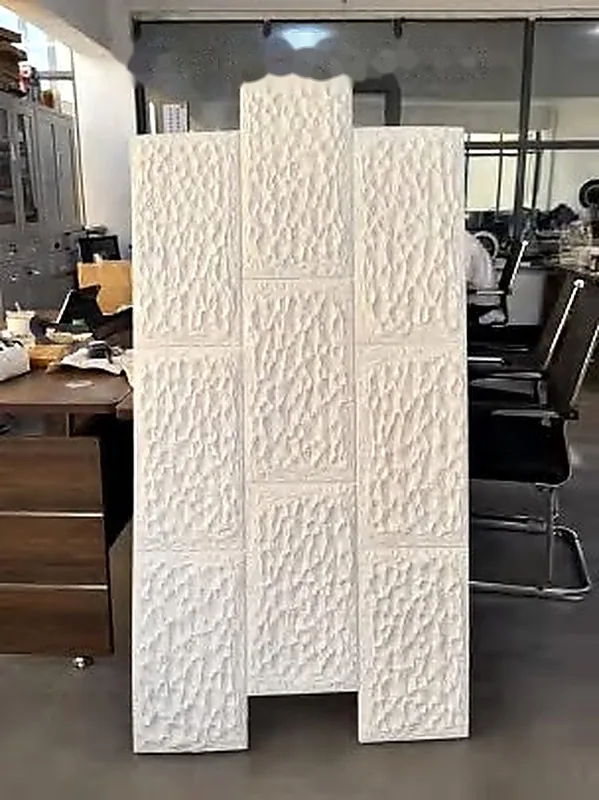
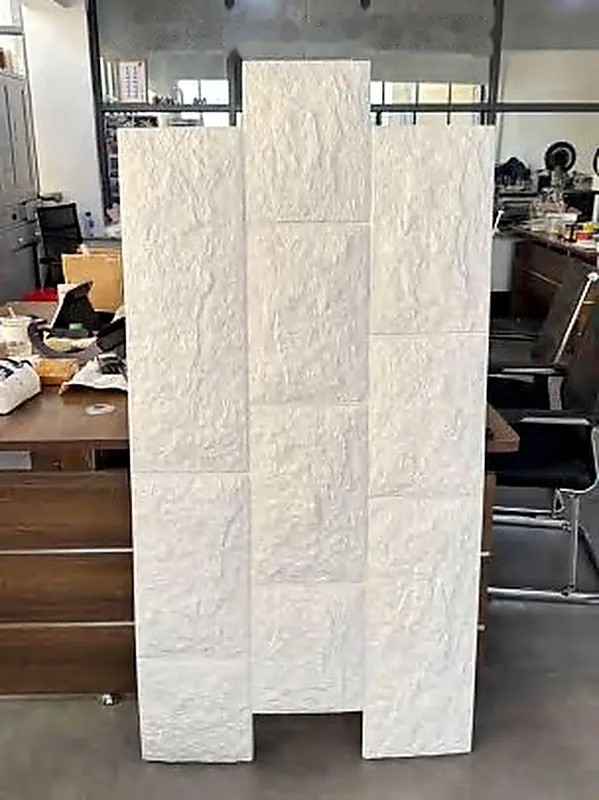
Two panels, one footprint, and 20 mm between them. 3 cm Exterior Tile PU Panel (TVD-1383) measures 1500 x 750 x 30 mm, and 5 cm Exterior Tile PU Panel (TVD-1384) measures 1500 x 750 x 50 mm. Both are lightweight PU stone-look panels, and both are named for exterior tile use. The listing describes TVD-1383 as a large-format tile-look relief and TVD-1384 as a deep-relief stone-look face. This guide is about choosing between the two, and about the thing that matters most outdoors in Canada: what happens in winter.
What the extra 20 mm does
Thickness is not only a measure. On a relief panel, it is the room that the designer has for shadow. A 50 mm panel can carry a deeper cut, so the face reads as more rugged from a distance and catches low sun in the evening. A 30 mm panel is subtler, closer to a large tile, and it adds less depth to the wall build-up, which matters at windows, door frames and corners, where each millimetre needs a trim detail.
| Code | Size from our listing | Character | Think of it for |
|---|---|---|---|
| TVD-1383 | 1500 x 750 x 30 mm | Large-format tile-look relief | Clean modern facades, porches, retail fronts |
| TVD-1384 | 1500 x 750 x 50 mm | Deep-relief stone-look face | Gate walls, boundary walls, feature entries |
Large panels, fewer seams
At 1500 x 750 mm, a single panel covers about 1.1 square metres, far more than a typical brick-look unit. A feature wall needs a lot fewer pieces, and fewer joints means fewer places for water to enter. It also means each piece is awkward on a ladder. Check the weight of one panel for the thickness you choose, because the listing gives the lightweight description but not the figure, and plan the crew and the access equipment on that number.
Outdoors in Canada: the questions that matter
- Freeze and thaw. A wall that is wet at midday and frozen overnight is working hard. Ask the maker how the panel and its fixing system have been tested for repeated freezing, and for the lowest temperature at which it can be installed.
- Sun. Colours fade, and a south wall in July takes more UV than most of the room. Ask for UV stability evidence and how the finish is applied.
- Movement. Plastic foam expands and contracts more than masonry. Joint spacing and fixing method must allow for it, and an installer needs written instructions.
- Drainage. Water that gets behind a panel must be able to escape. The wall assembly belongs to your designer, but the panel maker should describe how its product is meant to be used.
- Impact. Boundary walls and low entries get kicked, hit and splashed with salt. Ask what the face does when it is struck.
Checklist for the quote
- Thickness and weight for each code, with tolerances.
- The finish, the colour code and the match to your sample.
- Exterior rating, UV stability and freeze-thaw evidence.
- Fixing method, adhesive and accessories, with the lowest installation temperature.
- Corner and edge pieces for both thicknesses.
- Fire test reports for the exact thickness you order.
- Panels per pallet, pallet weight and crating.
Neighbours in the PU stone family
If you want a smaller brick pattern, the pair TVD-1381 and TVD-1382 measure 1200 x 600 mm. For a rock look in the same smaller size, there are Snow Peak Mountain Rock Panel (TVD-1387), Colour Sichuan Rock PU Panel (TVD-1389) and the faceted Colour Water-Cube PU Panel (TVD-1390). If you need variable depth, the Continuous-Grain Broken Stone Panel (TVD-1385) is listed for thicknesses from 20 to 100 mm. A builder's yard might stock TVD-1383 for general jobs and TVD-1384 for customers who want something heavier looking.
Certification and building rules
No Canadian certification mark is on file for either panel, and we do not claim one. Exterior cladding is a building-code matter: the designer and the building official decide whether a plastic foam panel is acceptable on a given wall, taking into account the building use, its height and how far it sits from the boundary. We have not seen a test report for these panels, so we say nothing about their fire behaviour. We confirm what exists for the exact thickness and supply the documents with the quote before you order. Codes are adopted province by province and change over time, so confirm with your building official. The compliance guide for PU stone panels sets out a full document list.
Freight and ordering
Large relief panels are bulky for their weight, so the container fills by volume rather than by load. Our Canada delivery hub explains how containers reach each province, and the landed cost calculator shows why packing density matters to the delivered cost. Submit the quote request with the wall areas and the delivery address; the written reply gives the price for the quantity, specification, certification status, packing, lead time and delivered cost. Many lines accept a low trial order and send samples on request. Payment is a 30% deposit and 70% before release, as laid out on how ordering works. See the PU stone line page for the rest of the range.