Product guide ·
Divided Glass Dishes (TVD-1882): Two-Compartment Borosilicate Dishes for Retail and Cooking Schools
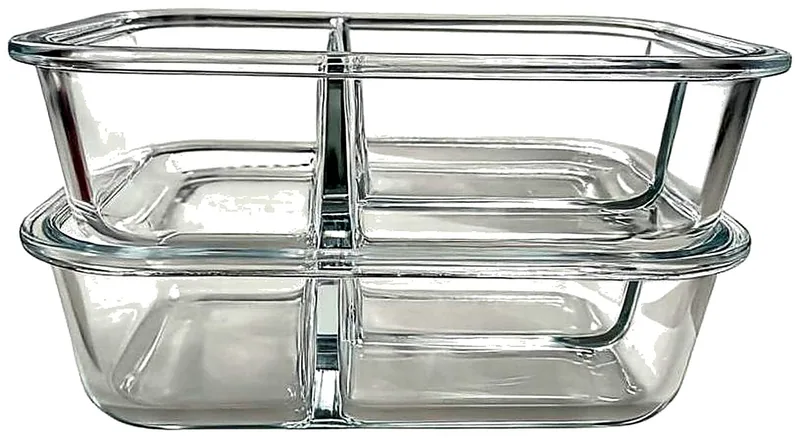
TVD-1882 is a set of rectangular borosilicate glass dishes with two compartments, stackable and made in several sizes. This guide covers who buys them, how to specify them and what Canadian buyers should request.
What a two-compartment dish does
The Divided Glass Dishes (TVD-1882) are borosilicate glass dishes in a rectangular shape with two compartments. Our listing adds that they are stackable and come in several sizes. A divider means two foods can share a dish without mixing, whether that is a roast and its vegetables or a main and a side. The stackable feature makes them practical to store, in a home cupboard or on a commercial rack.
The listing does not give the dimensions, the volume of each compartment, the maximum oven temperature or whether lids are included, and we do not guess. These are confirmed on your written quote. A free account on the site shows the full specifications on the product page.
Who buys divided glass dishes
- Kitchenware retailers. A divided dish stands out on a shelf of plain rectangular bakers because its purpose is easy to see. Shoppers who want portion control or meal prep find it without a long explanation.
- Cooking schools. A divider lets students cook two components side by side in one dish and keep them separate for comparison, which suits demonstrations and tasting. Cooking schools commonly ask about oven suitability and how the glass handles temperature changes, so have the factory's written guidance ready.
- Cafés and caterers. Glass shows food well and does not take on colour or odour, so a divided dish works for a hot side-by-side serve or for holding prepared components in a fridge. Check whether your health unit asks for any sanitation certification for the way you will use them.
- Online sellers. Meal prep is a search term, and a two-compartment glass dish fits it. Ask for the packed carton weight before you set a shipping charge; glass is heavy for its size and breakage allowances belong in your first-order plan.
- Discount and variety chains. Because it ships in several sizes, you can offer a small and a large dish at different shelf points from one code.
The listed features in practice
Borosilicate glass
Borosilicate is the glass type usually chosen for ovenware because it tolerates temperature change better than ordinary glass. Our listing says these dishes are borosilicate, but the way you describe them to customers should follow the factory's written statement about temperature limits, not general assumptions. Ask for the maximum oven temperature and the thermal-shock guidance for the specific dish, and whether freezer and dishwasher use are rated.
Two-compartment rectangular shape
A divider is a place where food and heat behave differently. Ask how the divider is formed, whether it is a moulded wall or a separate piece, and whether the corners are rounded for cleaning. A rounded internal corner is easier to scrub and matters to commercial kitchens.
Stackable, several sizes
Stackable glass dishes need a bumper or a defined base so that stacked glass does not scratch. Ask how the dishes are packed in the carton, whether each size is packed separately and what the set contents are. If you want to sell sizes individually, ask whether that is possible.
How to specify it: a checklist for your quote
- Dimensions, compartment volumes and glass thickness for each size offered.
- A written statement of the glass type and the maximum oven temperature.
- Thermal-shock guidance: fridge-to-oven, hot-to-cold and stove-top use if relevant.
- Whether lids are available, and what they are made of.
- Microwave, freezer and dishwasher suitability in writing.
- Food-contact test report and, if anything is printed or decorated, a lead and cadmium report.
- Packaging: carton quantity, dividers inside cartons, and the retail pack with bilingual text.
- Minimum order, sample availability and lead time.
Compared with other glass dishes in the line
If you want a plain rectangular baker, the Rectangular Glass Baking Dishes (TVD-1897) has moulded side handles, and the Rectangular Glass Baking Dishes – Nested (TVD-1883) is a nesting set in several sizes. For something with a lid, the Oval Glass Dishes – White Lid (TVD-1884) includes white lids and the Glass Casserole Dishes with Lid (TVD-1894) has twin side handles and glass lids. For roasting, the Ribbed Glass Roasting Dishes (TVD-1898) has a ribbed base. TVD-1882 is the answer when the buyer's question is how to cook or hold two things in one dish. The Glass Mixing Bowl Set guide covers the prep-bowl side of the same range.
Canadian rules for glass that touches food
The Food and Drugs Act prohibits selling food in or with materials that may make it harmful, and Health Canada does not pre-approve kitchenware, so buyers commonly ask for food-contact test reports. The Glazed Ceramics and Glassware Regulations set lead and cadmium limits for glassware that contacts food; plain clear glass is the simpler case, and any printed or coloured decoration near the lip is where a lead and cadmium report is expected. If the version you order has measuring marks, printing or coloured parts, mention it on the quote. No certification is on file for this product. We confirm certification status and supply the documents with the quote before you order. Our glass bakeware compliance guide lists every document to request across the line. Rules change; confirm with your health unit, inspector or customs broker. This is not legal advice.
Prepackaged retail sets need bilingual product identity and net quantity and the dealer's name and place of business under the Consumer Packaging and Labelling Act. For Quebec retail, instructions and warranty documents must be available in French.
Canadian use notes
- Winter freight. Glass is rigid, so the risk in cold freight is impact rather than frost. Ask for inner dividers and strong cartons, and have deliveries inspected for breakage on receipt.
- Commercial kitchens. Check what your health unit and landlord ask for, since some ask for sanitation certification on commercial food equipment.
- Landed cost. Glass is heavy, so freight is a large share of the delivered cost. See the landed cost calculator and the sales tax by province guide.
How ordering works
Every order is quoted in writing with the quantity, specifications, certification status and documents, packing, lead time and delivered cost to your address. We do not show prices on the site. Many lines have low trial order quantities and most items have samples, with the sample cost usually credited to your first order. Payment is 30% deposit and 70% before release, and goods from several factories can share one consolidated container. Read how ordering works and send a quote request naming TVD-1882. The Glass Bakeware, Cookware & Measuring line page and the wholesale guide show the full range, and the Canada delivery hub covers freight across Canada.