Product guide ·
Opal Glass Wavy-Rim Dinnerware (TVD-1900): Wholesale Guide for Canada
Opal glass bowls and plates with a flowing wavy rim. See how the shape affects stacking and dishwashing, and what to ask about the rim before you order.
Opal glass with a flowing rim
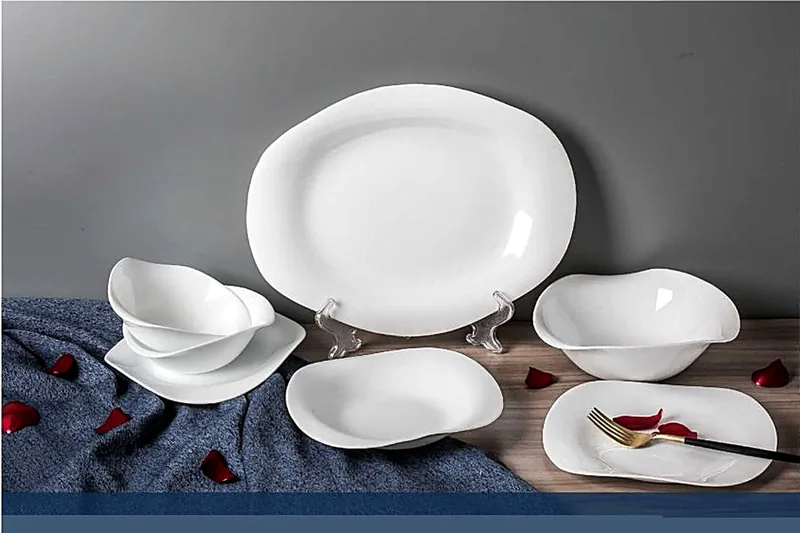
Opal Glass Wavy-Rim Dinnerware (TVD-1900) is an opal glass range whose defining feature is a flowing, wavy rim. Our product listing gives the sizes that matter for planning a menu: bowls from 6 to 12 in, plus flat plates, soup plates and oval plates. The individual plate sizes and the piece list for each set are confirmed on your written quote, because the listing does not give them.
A wavy edge changes how a plate looks and how it behaves. It softens the geometry of a table set with straight-edged furniture, it reads as hand-made to a guest, and it gives a chef a natural frame for food. It also changes handling, stacking and cleaning, and those are the things a buyer should check before putting a wavy-rim range into a dining room that turns tables fast.
Who buys it
- Restaurants choose a wavy rim to differentiate a table from the plain round plates that dominate the trade.
- Hotels use bowls up to 12 in as buffet and breakfast-room serveware and plates for the dining room.
- Cafés and brunch restaurants pair the soft rim with shared plates and desserts.
- Event planners and caterers use the oval plate and large bowl for platters and family-style service.
- Gift shops and home retailers sell it as a boxed set where the outline sells the product.
The wavy rim in service: stacking, racking and chipping
A wavy rim means that plates touch each other at the high points of the wave only, not around the whole circumference. That is good for breathing space between plates in a stack, but a wavy edge concentrates contact into a few points where chips can start. Ask for a stack-height drawing and a recommended stack count for storage, and ask how the factory packs plates so the high points do not rub against each other in transit.
In a commercial dishwasher, plates sit in racks designed for flat circular rims. A shaped edge may not seat as snugly as a plain one, so test a sample plate in the rack you actually use. Look for one thing in particular: whether plates click against each other under spray. If the rack needs a different peg arrangement, plan that before the order arrives, and train dish staff before the first service.
Sizes and how to choose
| Piece | Typical job in service | What to confirm |
|---|---|---|
| Bowls, 6 to 12 in | Soups, pasta, salads and shared bowls | Capacity of each bowl size |
| Flat plates | Main courses and breads | Exact diameter and rim depth |
| Soup plates | Wide-rim soups, risotto, pasta | Well depth and capacity |
| Oval plates | Fish, sharing platters, desserts | Length and width |
A tip for menu planning: pick the plate size that fits your largest dish first, then fill in the other sizes. A 12 in bowl is a serving vessel, not an individual portion bowl. Our listing does not state plate diameters, so the dimensions are confirmed on the quote, and a sample plate will show you how the wavy rim cuts into the usable area compared with a flat rim.
The rim and the lead and cadmium question
A shaped rim is a design feature of the glass itself. Decoration is something else: a printed band, a metallic line or a colour applied near the lip. Our listing describes the flowing rim as a shape, and does not describe any print. If your order includes any applied decoration, the Glazed Ceramics and Glassware Regulations apply: they set limits on lead and cadmium that can leach from glassware that contacts food, and decorated rims and metallic decorations near the lip are the known risk. In that case ask for a lead and cadmium test report for the exact decoration. For plain opal glass the report is still the standard request.
Beyond that, the Food and Drugs Act prohibits selling food in or with materials that may make it harmful, and Health Canada does not pre-approve kitchenware, so buyers rely on food-contact test reports. Restaurants may also be asked for NSF/ANSI or equivalent sanitation marks on commercial food equipment by their health unit, landlord or franchisor. No certification mark is on file for TVD-1900, so we make no certification claim. We confirm status and documents with your quote. Our compliance guide for decorated food glass and ceramic covers the document set for decorated pieces.
Rules change, so confirm current requirements with the authority that applies to you, your health inspector or your customs broker. This article is general information, not legal advice.
Alternatives in the line
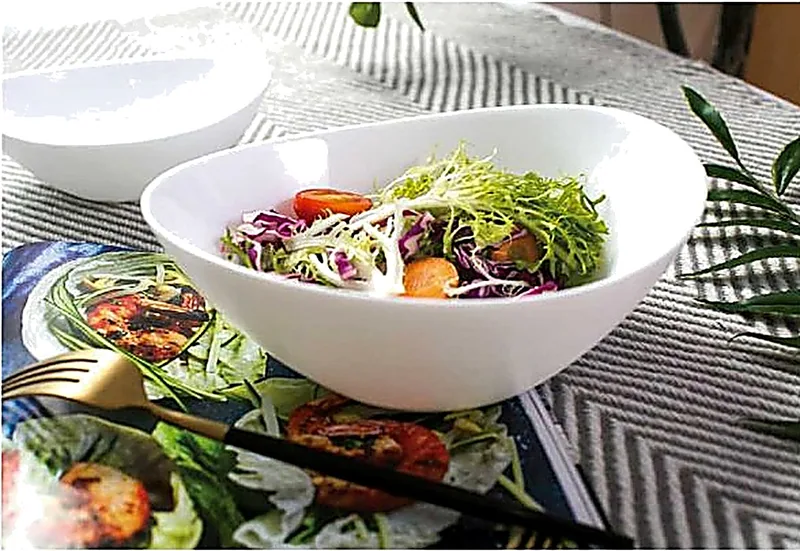
If a wavy rim is more edge than you need, TVD-1906 (Opal Glass Round Dinnerware – Fine Ring) offers a fine ring texture on a round shape, and TVD-1907 (Opal Glass Boat-Shaped Bowls & Plates) offers an oval boat form. For larger shape comparisons, our opal glass square dinnerware guide compares ten ranges, and TVD-777 (Opal Glass Dinner Sets) covers plates, bowls and platters for restaurants and hotels. Mugs and cups are in TVD-779 (Opal Glass Mugs & Cups).
Canadian buying notes
Heat and dishwasher claims are only made when the factory rates the glass; our listing for this range does not state a rating, so ask for it before you promote microwave or oven use. Opal glassware is heavy by the pallet, so plan for forklift delivery to a loading dock. Quebec buyers selling prepackaged sets need French labelling at least as prominent as English, and elsewhere prepackaged goods need bilingual product identity and net quantity. For taxes, see the sales tax by province guide; the landed cost calculator helps you estimate a delivered total.
Ordering
A written quote gives the price for your quantity, specifications, certification status and documents, packing, lead time and delivered cost. Samples are on most items with the cost usually credited to your first order, trial quantities are low on many lines, and payment is 30% deposit and 70% before release. See how ordering works, the Glass Food Storage & Tableware line page, or send a quote request.