Certification guide ·
PET Wall Sticker, Silent Grille (TVD-1410): Certification and Import Checklist
TVD-1410 has no certificate on file. A grille design invites questions about electricity and acoustics, so this guide separates what we know from what we confirm.
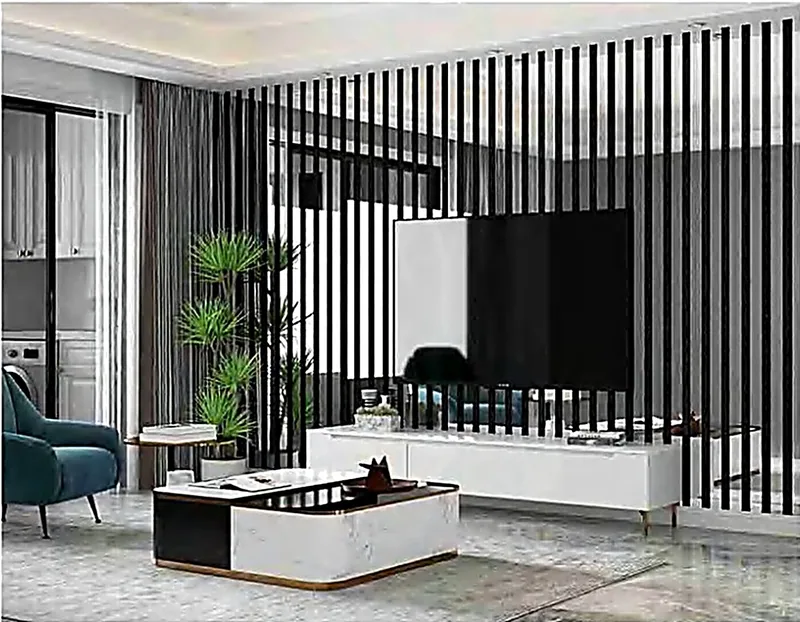
Products with a technical-sounding name attract technical assumptions. PET Wall Sticker - Silent Grille (TVD-1410) is described in our listing as a peel-and-stick PET wall panel with easy dry installation on flat walls and a wide choice of patterns and colours. That is all we know from the listing, and it is a film. We hold no certificate or test report for it, and we make no safety, acoustic or ventilation claim. This guide explains which Canadian rules could apply and how we settle them.
Starting point: what is it?
Every compliance answer depends on construction. A plain printed film is judged as an interior finish. If any version includes a powered or lit part, electrical rules come into it, and that changes the paperwork completely. Before we offer a quote we ask the factory to state the construction in writing: film only, film bonded to a board, or anything beyond. The rest of this guide is conditional on that answer, which is why you will see the word "if" often.
Rule set 1: interior finish and flame spread
The National Building Code of Canada limits the flame-spread rating of interior wall and ceiling finishes. Provinces adopt the code with changes; Quebec, Ontario, British Columbia and Alberta publish their own. The test method is CAN/ULC-S102. How strict the limit is depends on the building use and on where the surface is: exits and corridors face the strictest limits, and a private room is easier. For a thin film, ask what substrate the laboratory used, since the result can depend on it. US reports to ASTM E84 are common with imports, and some officials accept them case by case, but CAN/ULC-S102 is what Canadian designers usually ask for.
Rule set 2: electrical, only if there is a powered part
Electrical products sold or installed in Canada must carry a certification mark from a body accredited by the Standards Council of Canada, such as CSA, cUL or cETL, or a field evaluation label. Provincial and territorial electrical safety authorities enforce the rule, and inspectors can refuse uncertified equipment. A US-only UL or ETL mark, without the small c, is not enough, and a CE mark is not recognised as proof of compliance in Canada. Canadian supply is 120 V or 240 V single-phase at 60 Hz, and equipment built for 220 V at 50 Hz must be confirmed before ordering. Nothing in our listing suggests TVD-1410 has any such part, so for now this is a precaution, and our guide to the certification marks explains it in more detail.
Rule set 3: wood-based boards
If the version you order is bonded to a wood-based board such as MDF or particleboard, Canada's formaldehyde emission rules for composite wood products apply: emission limits, certification by an approved third-party certifier and labelling. We request the certificate if that is the case.
Rule set 4: imports and language
Duty depends on tariff classification and country of origin, and GST, HST, PST or QST apply by delivery province. Our customs broker confirms classification before we quote a delivered cost. For Quebec, labels, instructions and warranty documents must be available in French. Prepackaged consumer goods follow federal bilingual labelling rules, with the dealer's name and place of business.
What we will not say
We will not say the product reduces noise, because the listing does not claim it. We will not say it passes any fire test, because we have none. We will not say it is non-combustible, which refers to a different test, CAN/ULC-S114. And we will not say it suits wet areas or heat sources until the maker has put it in writing. If your project depends on any of those, put it on the quote request.
Document table
| Document | Why you want it | Who issues it |
|---|---|---|
| Written construction statement | Settles which rule sets apply at all | Manufacturer |
| Flame-spread report, substrate named | Compare with the code limit for the room | Accredited test laboratory |
| Electrical certification, only if a powered part exists | Inspectors and insurers will ask | Certification body accredited by the Standards Council of Canada |
| Formaldehyde certificate, only if a wood-based board exists | Needed for regulated composite wood | Approved third-party certifier |
| Adhesive and removal guide | Substrate, temperature, tenants | Manufacturer |
| French-language documents | Quebec buyers and chains | Manufacturer, translated |
Consequences of a gap
An inspector may refuse a finish in a corridor, an electrical authority can refuse a powered part with no mark, and a retailer can decline unlabelled goods. Each would be avoidable with the right document in hand.
Our handling
When you send a quote request, tell us the building type, the province and where the film goes. We confirm certification status and which documents exist, and attach them to the written quote before you pay. If a report is missing, we say so. The sequence afterwards follows how ordering works: 30% deposit, 70% before release. This is general information, not legal advice, and rules change, so confirm with your building official, inspector or customs broker. For buying advice on the film itself, read the product guide for TVD-1410. For the whole line, see the line-wide compliance guide, and for a related finish, the glossy marble guide.