Certification guide ·
Rectangular Tray – Frosted Glass Insert (TVD-5715): Canada Certification and Compliance Guide
A frosted glass base and side grips mean glass, finish and carrying safety all deserve questions. No certificate is on file for this tray, so here is what to request.
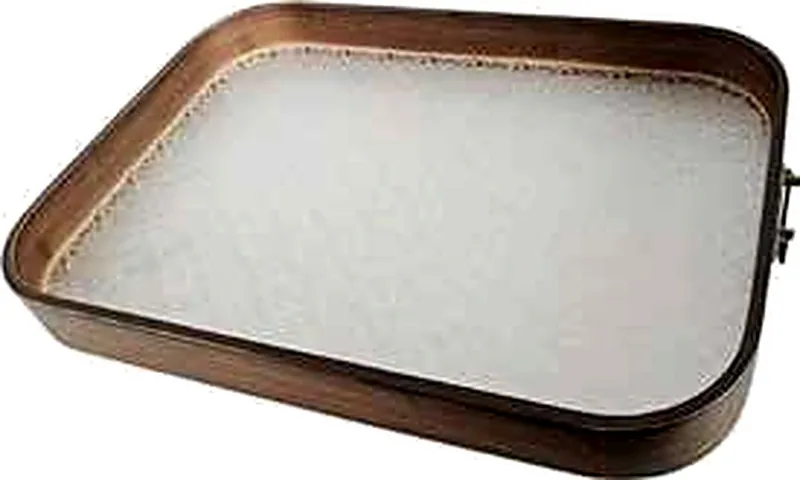
This guide is for the buyer who has chosen Rectangular Tray – Frosted Glass Insert (TVD-5715) and now needs to know what paperwork to ask for in Canada. The tray has a dark bamboo rim, a frosted glass base and side handle grips. It is a hand-carried serving tray with no powered part in its listed features, so the compliance picture is about glass, finishes, food contact and labelling. We do not hold a certificate or test report for it today, and nothing here says the tray is certified. We confirm the certification status and supply documents with the written quote before you order; this page explains what to expect and why.
Three questions that drive the document list
- How was the frosting made? A frosted base can be etched or sandblasted into the glass, or it can be a coating applied to the surface. The first is a physical finish; the second is a layer you need a supplier to describe and, for food-contact use, to test.
- What touches food? The glass face, the bamboo rim and the adhesive or sealant between them can all be in contact with items served on the tray. Each needs to be covered by a test or a clear statement.
- Who will use it? A hotel room tray, a restaurant service tray and a giftware item are viewed differently by buyers, health inspectors and retail chains, even though the physical product is the same.
Glass and the lead and cadmium limits
The Glazed Ceramics and Glassware Regulations, made under the Canada Consumer Product Safety Act, limit the lead and cadmium that can leach from glazed ceramics and glassware that contact food. The risk concentrates on decoration, especially decorated rims and printed or metallic decorations near the lip. A frosted base without painted or printed artwork is a lower-risk situation than a decorated one, but the correct way to treat the question is to ask the factory to state in writing how the base is produced, and to supply a lead and cadmium report if any applied decoration or coating is present. We pass the answer to you on the quote.
Bamboo, finish and adhesive
Health Canada does not pre-approve kitchenware. The Food and Drugs Act prohibits selling food in or with materials that may make it harmful, so the evidence is test-based. For the bamboo rim, buyers commonly request food-contact migration reports for the finish and for the glue, and some ask for them to FDA or EU methods. Bamboo blended with melamine is not for microwave use. For a tray whose glass is held in a groove with sealant, the sealant also matters, and we confirm what is used.
Handles and consumer safety
The Canada Consumer Product Safety Act prohibits consumer products that are a danger to human health or safety, requires incident reporting and allows recalls, and Health Canada enforces it. For a tray with side grips and a glass panel, the realistic safety concerns are the panel releasing under load, a chipped edge at the glass, or a grip detaching. These are build-quality questions rather than certification questions, so the best evidence is a sample, a description of how the glass is seated, and the factory's stated carrying limits. Ask for them in writing.
Document checklist
| Document | Why you need it | Who issues it |
|---|---|---|
| Statement of how the frosting is produced | Separates a glass finish from an applied coating | The factory, confirmed on the quote |
| Lead and cadmium leaching report, where any applied decoration exists | Supports the limits for glassware that contacts food | An independent laboratory |
| Food-contact migration report for the rim finish | Evidence for the bamboo surfaces | An independent laboratory |
| Adhesive or sealant description | Covers the joint between glass and frame | The factory |
| Carrying and care instructions | Prevents misuse and returns; French version needed for Quebec | The factory, translated as needed |
| Bilingual label artwork | English and French identity and net quantity, with dealer name and place of business | You and us, before printing |
What does not apply, and what would change that
Because no powered component is listed, electrical certification marks do not apply to this tray. If a version you order includes a light, heater or battery, electrical products in Canada must carry a certification mark from a body accredited by the Standards Council of Canada, such as CSA, cUL or cETL, or a field evaluation label, and a US-only mark is not enough. The CE mark is not accepted as proof of compliance in Canada either. See CSA, cUL and cETL marks explained for the differences. Also note that the surface coating rules, with their lead limit for coatings on furniture and children's products, are not aimed at a serving tray, but a lead test on painted parts is still a reasonable supplier request.
Provincial notes
The federal rules above apply in every province. The practical differences are language and the local inspector. In Quebec, the Charter of the French language requires product labels, instructions and warranty documents to be available in French, with French at least as prominent as English. Restaurants and hotels should confirm with their local public health unit and any franchisor what they require for serviceware. Rules change and this is not legal advice, so confirm current requirements with Health Canada, your health inspector or your customs broker.
If a document is missing
A retail chain can decline to list a glass item without a lead and cadmium report; a hotel purchasing office can reject goods at approval; an unsafe product can be recalled, and the dealer carries the cost. Asking early is the sensible fix.
How we handle it
When you request a quote, we check what documents exist for this tray, state the certification position plainly and supply the reports in hand before you order. Where something is missing we say so and talk through whether testing on your order is possible. Our customs broker confirms the tariff classification before we quote a delivered cost, and the applicable GST, HST, PST or QST follows the province of delivery; see the sales tax by province guide. Samples are available on most items, with the cost usually credited to the first order, and payment is 30% deposit and 70% before release.
For the buying side of this tray, read the buyer guide for TVD-5715. For comparison across the range, see the bamboo tray compliance guide for the whole line. More on the process is on how ordering works.