Certification guide ·
Round Bamboo Tray – Gold Rim (TVD-5710): Canadian Certification and Compliance
A decorated bamboo tray needs food-contact and lead evidence, not an electrical mark. Here is the document checklist and the labelling rules by province.
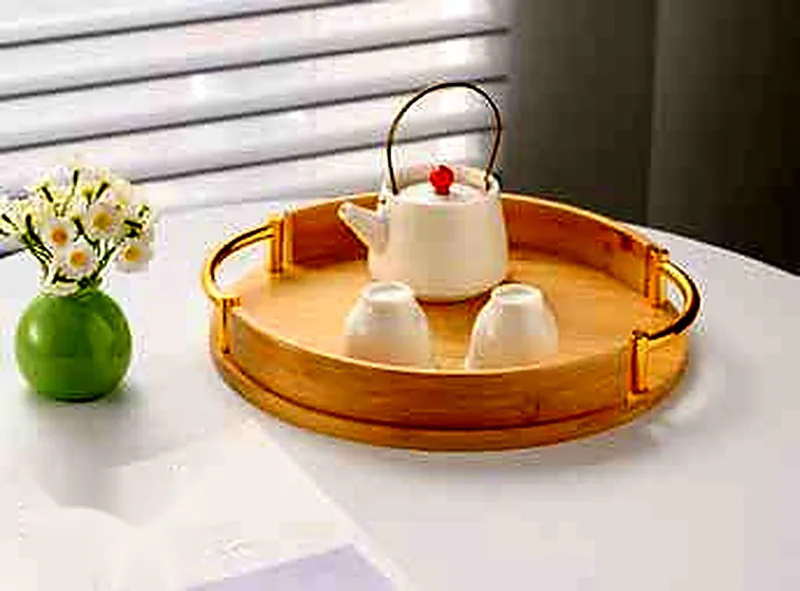
This guide explains which Canadian rules apply to the Round Bamboo Tray – Gold Rim (TVD-5710), a round bamboo tray with a gold-tone rim that suits teapot and cup sets. It is not powered and has no glass part in its listed features, so there is no electrical or gas mark to chase. The questions are about decoration, food contact and labelling. To state it plainly: we do not hold a certification document for this tray at present. We confirm certification status and supply the documents with the quote before you order. For the commercial side see the buying guide for this tray.
The rules that apply to a decorated bamboo tray
Food and Drugs Act. Food must not be sold in or with materials that may make it harmful. A tea tray is not a plate, but it is used with food and drink, and a hotel or tea room will ask whether its surfaces are food-safe. Health Canada does not pre-approve kitchenware, so evidence comes from test reports.
Lead limits. The Consumer Products Containing Lead Regulations set lead limits that include kitchen utensils and products for young children. A gold-tone rim is a decorative layer, and if it is a metallic paint or plating, a lead and heavy-metal report is the sensible document to request.
Glazed ceramics and glassware. The Glazed Ceramics and Glassware Regulations under the Canada Consumer Product Safety Act limit lead and cadmium that can leach from glazed ceramics and glassware in contact with food, and decorated rims and metallic decorations near the lip are a known risk. These limits apply to ceramics and glass, not to bamboo, but if you pair the tray with cups or a teapot, those pieces need their own test report.
Canada Consumer Product Safety Act. It prohibits consumer products that are a danger to human health or safety, requires incident reporting and allows recalls. Health Canada enforces it.
Document checklist
| Document | Why it matters | Who issues it |
|---|---|---|
| Food-contact test report for the bamboo and finish | Evidence the surface is suitable for use with food and drink | Independent laboratory, obtained through the factory |
| Lead and heavy-metal report on the rim | Covers the metallic decoration and supports the lead limits | Independent laboratory |
| Rim finish declaration | States whether the rim is metal, paint, foil or plating and where it sits on the tray | Factory, confirmed on our quote |
| Adhesive and lacquer declaration | Bamboo parts are glued; finishes and glues are checked for food contact | Factory |
| Test reports for paired cups or teapot (if you sell a set) | Glazed ceramics and glassware have their own lead and cadmium limits | Whoever supplies the cups or pot |
| Bilingual label artwork | Product identity, net quantity and dealer details in English and French | You or us, approved before printing |
| Customs classification | Duty and taxes depend on classification and origin | Our customs broker |
CE marks, UL marks and why they do not help here
Canada does not recognise the European CE mark as proof of compliance for consumer products. A CE-marked tray still needs to meet the Canadian rules above. Electrical marks such as CSA, cUL and cETL concern powered goods and do not apply to a bamboo tray; if you also buy lit decor or appliances, our CSA, cUL and cETL marks explains the difference. For this tray, test reports and declarations are the paperwork that counts.
Provincial differences
- Quebec: the Charter of the French language expects labels, instructions and warranty documents in French, at least as prominent as any other language. Quebec retailers will ask for this.
- All provinces: prepackaged consumer products need bilingual product identity and net quantity under the Consumer Packaging and Labelling Act, plus the dealer's name and place of business.
- Health units: a hotel, tea room or café will answer to its local public health inspector, and some franchisors add their own documentation rules. Ask your buyer what is required before you order.
What happens if the documents are missing
A retailer's compliance team may refuse to list the item, a hotel's procurement group may decline to approve it, and a customs or marketplace review can ask for test evidence on short notice. If a problem is found after sale, recall and incident-reporting duties under the CCPSA fall on the importer. A rim that chips and flakes into food is the sort of complaint that starts one. Asking for a lead report and a wear test before you order costs far less.
How we handle it
On your written quote we state the rim method, supply or request the food-contact and lead reports, tell you which are available now and which require a lab test, and list the labelling you need for your market. We confirm classification with our customs broker before we state a delivered cost; the sales tax by province guide explains how provincial taxes apply. If a retailer needs additional evidence, we ask the factory. Rules change, so confirm requirements with the authority, your inspector or your customs broker. This is general information, not legal advice.
Ordering follows how ordering works: written quote, samples on most items with the sample cost usually credited to the first order, a 30% deposit and 70% before release. To start, request a quote. The full range is in our Bamboo Serving Trays product line.