Certification guide ·
Acoustic wall panel certification in Canada: the paperwork behind TVD-064
Wood-veneer slat panels on acoustic felt are easy to specify and easy to get stuck at plan review. Here is what Canadian buyers need on file, and where TVD-064 stands today.
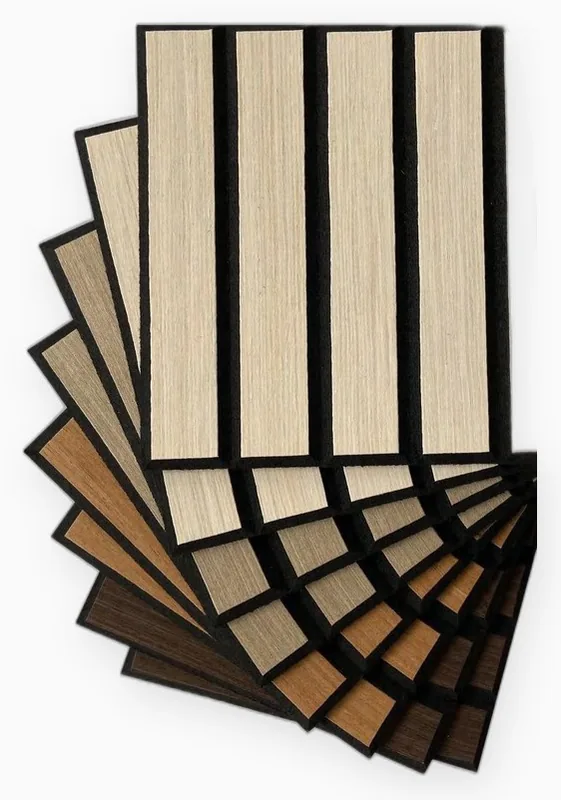
Buyers who search for acoustic wall panels certification in Canada usually want one answer: what paperwork will a designer, building official or landlord ask for before the panels go on the wall? This guide covers TVD-064 Wood Veneer Acoustic Slat Panel, a natural wood-veneer slat panel on PET acoustic felt, supplied as a standard 1200 × 2400 mm sheet, installed by screw or adhesive and described in its product facts as E1 grade.
Where TVD-064 stands today
No certification mark, test report or approval is on file for TVD-064 at the time of writing, so we make no claim that it meets any Canadian fire, emissions or acoustic requirement. The product facts describe how the panel is built. They are not Canadian proof. Before you order, we confirm certification status for the exact panel and supply the documents with the written quote. If a document does not exist for the thickness and finish you want, you hear that before any deposit is paid.
Which Canadian rules touch a wood-veneer acoustic panel
A passive wall panel is not an electrical or gas appliance, so the CSA, cUL and cETL marks described in our guide to those marks are not the central question. They matter if you add lighting or powered parts around the panels. For the panel itself, four topics decide whether it is accepted:
- Flame-spread rating. The National Building Code of Canada, adopted with changes by each province, limits the flame-spread rating of interior wall and ceiling finishes. The test is CAN/ULC-S102, and the limit depends on building use and location. Exits and corridors are the strictest.
- Composite wood emissions. If the slats or core contain composite wood such as MDF, the Formaldehyde Emissions from Composite Wood Products Regulations apply: emission limits, certification by an approved third-party certifier, and labelling. This product may contain composite wood, so we treat it as in scope until the core is confirmed.
- Acoustic performance. Sound absorption is stated as an NRC (noise reduction coefficient) from a lab test. The figure only means something when you also have the report and the mounting type used in the test.
- Consumer-product basics. If panels are packed and sold to consumers, bilingual identity and quantity labelling under the Consumer Packaging and Labelling Act applies, and the Canada Consumer Product Safety Act's general safety duties sit behind it.
Document checklist for acoustic slat panels
Ask for these before you commit to a quantity. Several can be requested from the factory while the quote is prepared.
| Document | Why it matters | Who issues it |
|---|---|---|
| CAN/ULC-S102 flame-spread report for the exact panel and thickness | Shows the finish can sit within the limit set for the room's use | Accredited fire-test laboratory, obtained through the factory |
| ASTM E84 report (US test), if that is what exists | Designers and building officials in Canada usually want CAN/ULC-S102 results or will review an E84 report case by case | Test laboratory |
| Formaldehyde certificate (TSCA Title VI or Canadian compliance certificate) | Evidence that composite wood parts meet the emission limits and are labelled | Approved third-party certifier |
| NRC sound absorption report with mounting type | The only sound basis for an acoustic claim in a specification | Acoustic test laboratory |
| Material declaration: slat, core, felt, veneer species, finish | Tells the reviewer which rules apply to which part | Factory, confirmed on our quote |
| Bilingual labels and, for Quebec, French documents | Required for prepackaged consumer products; expected by Quebec retailers and specifiers | Us, for your shipment |
| Customs classification (HS code) and origin | Sets import duty; taxes follow the province of delivery | Our customs broker |
CE marks and European grades are not Canadian proof
Factory data sheets sometimes carry a CE mark or a European emission or fire class. Canada does not recognise the CE mark as proof of compliance for electrical, gas or consumer products, and an emission grade printed on a data sheet is not the same thing as a third-party certificate issued under the Canadian formaldehyde rule. Treat those papers as useful background and still ask for the Canadian documents above.
Provincial differences to plan for
Quebec, Ontario, British Columbia and Alberta each have their own building code, and the other provinces adopt the national code with changes, so the exact flame-spread limit for a room is set locally. In Quebec the Charter of the French language also expects labels, instructions and warranty documents to be available in French, and Quebec retailers will ask. Our Canada delivery hub lists each province, and the Alberta guide to acoustic wall panels shows how the same panels are bought on the Prairies.
What happens when a document is missing
- The designer or building official can decline the finish at plan review, or refuse it on the wall of a corridor or exit.
- A general contractor may stop installation until a report is produced, and an insurer can question an untested finish.
- A retailer or franchisor may refuse to list product that arrives without emission or labelling paperwork.
- Remedial testing of a sample at a Canadian laboratory is possible, but it adds time and cost to a project that was planned without it.
We do not claim any panel in this range is non-combustible. If your drawings call for non-combustible construction, which refers to CAN/ULC-S114, tell us at the quote stage so the question is settled before anything ships.
How we handle certification on a quote
Every order is quoted in writing. The quote states the specification, the certification status, the documents we can supply, packing, lead time and delivered cost to your address. You can request a sample first, and its cost is usually credited to the first order. Payment is a 30% deposit and 70% before release. The full process is on our how ordering works page, and you can start with the quote request. For the product itself, read the TVD-064 wholesale buying guide. Taxes depend on the delivery province; see our sales tax by province guide.
Rules change, and this page is general information, not legal advice. Confirm what applies with your building official, the provincial authority, your inspector or your customs broker.