Certification guide ·
Heavy duty planetary mixer: food contact, motor and paperwork in Canada
A mixer is judged first on what touches the dough, then on the motor. Here is what to gather for TVD-10815 before it ships.
Food contact is the headline, electricity the footnote
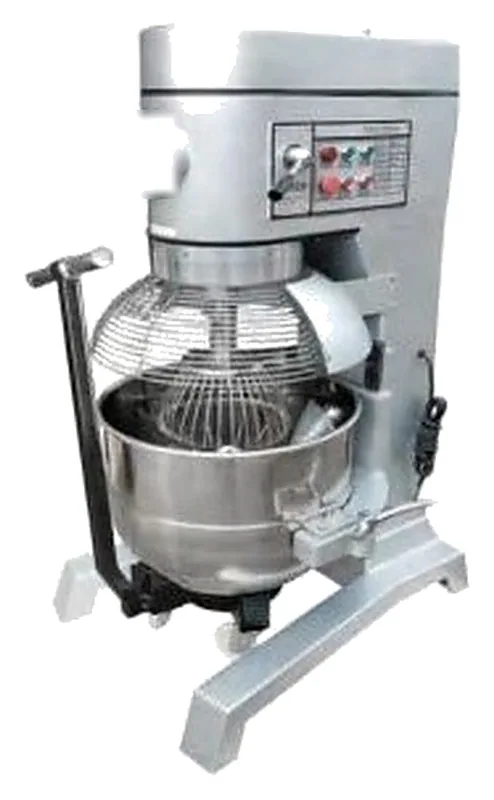
The Planetary Mixer, Heavy Duty (TVD-10815) is food equipment first. That fits what the machine does: a rotating attachment working dough or batter inside a bowl. But it is also a motor-driven machine that is plugged in or hard-wired, and the Canadian electrical rules apply to anything of that kind, whatever its food-equipment description suggests. Bench and floor models are offered, with a bowl guard, for bakery and pastry use.
No certification mark is on file for TVD-10815. We confirm the certification status and supply the documents with the quote before you order.
The food-contact parts, one by one
- Bowl. The largest surface touching food. Ask for the material, grade and finish.
- Attachment. Whatever turns in the bowl. Ask which are supplied and their materials.
- Bowl guard. Not always food-contact, but it sits over the food and must be cleanable.
- Shaft seal and lubricant. Ask whether the lubricant near the attachment shaft is food-safe, since a drip into a batch is the classic failure.
Provincial food premises regulations and public health inspectors expect equipment to be durable, easy to clean and sanitary. The Food and Drugs Act prohibits selling food in or with materials that may make it harmful. Health Canada does not pre-approve kitchenware, so buyers commonly ask the factory for food-contact test reports. Many inspectors, landlords and franchisors also ask for NSF/ANSI or an equivalent sanitation certification on commercial food equipment; check what yours asks.
The motor and the guard
Electrical products must carry a certification mark from a body accredited by the Standards Council of Canada, such as CSA, cUL or cETL, or a field evaluation label; the CE mark is not recognised, and a US-only mark is not enough. Commercial food preparation machines sit in the broader kitchen-equipment family, so ask the factory which Canadian standard its mark refers to. Check that the mark covers the motor and control, not just the housing. The guard raises a separate question: does it interact with the motor, so the attachment stops or slows when the guard is lifted? We do not quote a rule for that, because it depends on the design and your authority. Ask for a written description of the arrangement, and show it to your inspector.
Power: where bench and floor models diverge
| Check | Why it matters for this mixer | Detail we confirm on the quote |
|---|---|---|
| Voltage and phase | Floor machines may want three-phase; Canadian commercial supply is 208 V or 600 V three-phase, or 120 V and 240 V single-phase | Nameplate values and plug or hard-wire connection |
| 60 Hz | A motor built for 220 V / 50 Hz can overheat or run wrongly at 60 Hz | Written confirmation of Canadian frequency |
| Starting and run current | Sets breaker and wire size | Amperage |
| Mounting | Bench needs a strong counter; floor needs a level, anchored base | Dimensions and weight |
Documents to collect
| Document | Purpose | Issued by |
|---|---|---|
| Canadian electrical mark or field evaluation label | Electrical authority and insurer | Accredited certification body |
| Material list for bowl, attachment and guard | Food-contact review | Factory |
| Food-contact test report | Supports the Food and Drugs Act expectation | Factory or test lab |
| NSF/ANSI or equivalent, if requested | Health unit, landlord, franchisor | Accredited sanitation certifier |
| Guard and motor arrangement description | Inspector discussion | Factory |
| French manual and warranty (Quebec) | Charter of the French language | Factory, translated on request |
Cleaning and changeover
A mixer that bakes the day away has to be cleaned between products, and the design of the bowl, the attachment and the guard decides how long that takes. Ask which parts come off without tools, which crevices trap batter and whether the machine can be hosed or must be wiped. A health inspector will look at these places first, and your own staff will tell you quickly if the answers are poor.
Regional notes
Electrical authority names differ: the Electrical Safety Authority in Ontario, and other provincial bodies elsewhere. Quebec buyers need French documentation. Winter freight can chill a machine, so let it come to room temperature before powering up. Our regional buying guides for Ontario and Alberta give local context.
If the mark or the reports are missing
An inspector can refuse a machine without a Canadian electrical mark, a health unit can ask for the food-contact paperwork you do not have, and a franchisor can reject the item altogether. The most common surprise is a bakery that has ordered a machine and only then learns the landlord insists on a sanitation certificate.
How we handle it
The quote lists the model type, electrical ratings, materials, certification status and the documents we hold. We scope any field evaluation before you commit, and payment is 30% deposit and 70% before release; see how ordering works. For other gas and electric kitchen items, compare the gas range with oven guide and the fryer guide. Send details through the quote request. Rules change, so confirm with your inspector, the electrical authority or your customs broker. This is general information, not legal advice. See also the commercial kitchen equipment line.