Certification guide ·
Round Tray – Patterned Glass Insert (TVD-5714): Canada Certification and Compliance Guide
Glass that touches food brings Canadian lead and cadmium limits into play. No certificate is on file for this tray, so here is what to request and why.
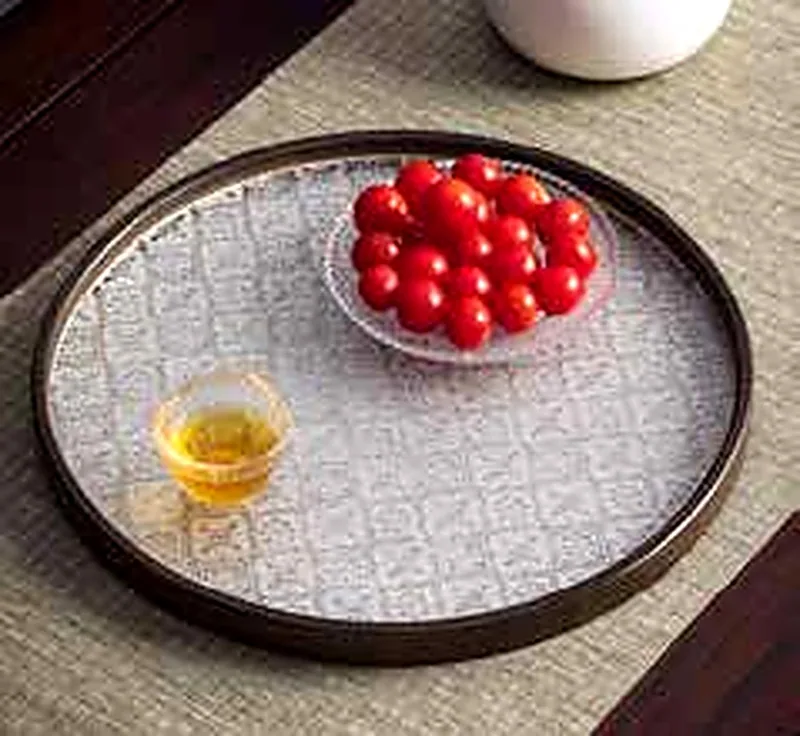
Round Tray – Patterned Glass Insert (TVD-5714) combines a dark bamboo rim, a patterned glass base and a round serving size. For compliance, that mix puts two material families in one product: bamboo, which raises food-contact and finish questions, and glass, which brings in the Canadian limits on lead and cadmium for glassware that contacts food. No certificate or test report for this tray is on file with us at the moment, so we make no claim that it is certified or approved. What follows is what a Canadian buyer should request, how to read it, and what we do on the quote to confirm each point before you order.
The rules that matter most for a glass-base tray
- Glazed Ceramics and Glassware Regulations. Made under the Canada Consumer Product Safety Act, these set limits on the lead and cadmium that can leach from glazed ceramics and glassware that contact food. Decorated rims and printed or metallic decorations near the lip are a known risk, and the standard advice is to ask the factory for a lead and cadmium test report on any decorated glass.
- Food and Drugs Act. It prohibits selling food in or with materials that may make it harmful. Health Canada does not pre-approve kitchenware, so buyers rely on supplier test evidence, for example food-contact migration reports to FDA or EU methods.
- Bamboo finishes and glues. Ask for food-contact tests on the rim finish and on the adhesive or sealant that holds the glass in the frame. Bamboo blended with melamine is not for microwave use.
- Consumer product safety. The Canada Consumer Product Safety Act prohibits products that are a danger to health or safety, requires incident reporting and allows recalls. A glass panel that can release from its frame under normal use is the sort of fault this covers.
Whether the pattern on this base is moulded into the glass or applied to its surface is confirmed with the factory on your quote. It decides whether a decoration test is relevant, so it comes first in the document request.
Document checklist
| Document | Why it matters | Who issues it |
|---|---|---|
| Lead and cadmium leaching report for the glass | Addresses the Canadian limits for glassware that contacts food | An independent laboratory, through the factory |
| Statement of how the pattern is made | Separates moulded texture from printed or metallic decoration | The factory, confirmed on the quote |
| Food-contact migration report for the rim finish | Shows the bamboo coating was tested for food contact | An independent laboratory |
| Adhesive or sealant description | Identifies what bonds glass to bamboo | The factory |
| Glass type and thickness note | Explains how the base will break and how to pack it | The factory |
| Carton and drop-test packing details | Limits breakage claims | The factory, through us |
| Bilingual label artwork | English and French identity and net quantity with dealer details | You and us, before print |
CE marks and foreign test statements
A CE mark does not show compliance in Canada for consumer products, so do not accept it as a substitute for the Canadian requirements above. European food-contact reports can still be valuable evidence, and so can FDA reports, but a Canadian buyer should read them for what they actually tested: which surfaces, which food simulants and which limits. Reports that test only the bamboo and ignore the glass decoration do not answer the lead and cadmium question.
Where provinces differ
The glassware limits and the food and consumer safety rules are federal. The differences show up elsewhere. In Quebec, the Charter of the French language requires labels, instructions and warranty documents to be available in French, and French must be at least as prominent as English. Commercial buyers such as hotels and restaurants should also check with their local public health unit and any franchisor, because food premises rules require equipment and utensils that are durable, easy to clean and kept sanitary, and some inspectors or landlords ask for specific sanitation marks on food equipment. A decorative serving tray often falls outside those requirements, but it is better to ask than to assume.
Consequences of a missing document
- A retail buyer may refuse to list a glass product that has no lead and cadmium report.
- A hotel group's purchasing office may refuse delivery of a tray without a food-contact statement.
- If a tray proves unsafe, a recall can follow, and the importer or dealer bears the cost of withdrawing stock and handling complaints.
- Insurers can ask questions about products that were sold without supporting documentation.
What we do on the quote
We confirm the certification status of this tray and the documents available, and supply them with the quote before you order. If a lead and cadmium report or a food-contact report does not exist for the exact product, we say so and discuss having testing carried out on your order. We also confirm the tariff classification through our customs broker so the delivered cost reflects the correct duty, and GST, HST, PST or QST are applied for your province, as the sales tax by province guide explains. Samples are available on most items and the cost is usually credited to your first order, so you can examine the glass edge, the joint and the finish yourself. Payment is a 30% deposit and 70% before release. Learn more on how ordering works.
Rules change, and this guide is not legal advice. Confirm current requirements with Health Canada, your health inspector or your customs broker. For the commercial view of this tray, including who buys it and how it compares with the rectangular frosted version, read the buyer guide for TVD-5714. You may also want the bamboo tray compliance guide for the whole line if you are comparing trays across the range. When you are ready, request a quote and name the quantity and address.