Certification guide ·
Multi-Function Vegetable Dicer (TVD-1780): What Canadian Importers Need Before It Ships
A dicer with interchangeable blades and a container touches food and has cutting edges, so food-contact and safety documents matter more than any electrical mark. Here is the checklist.
Status of the Multi-Function Vegetable Dicer
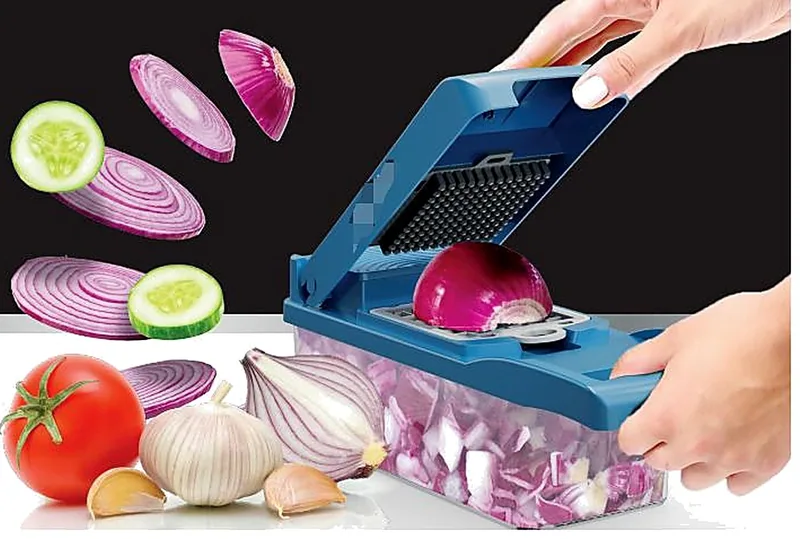
The Multi-Function Vegetable Dicer (TVD-1780) is described as a dicer and slicer with a container and interchangeable blades, for potato, onion and cucumber. No certification or test report is on file for this code, and we do not claim that it is certified, approved or compliant with any standard. This post lists what a Canadian buyer should require and the documents to ask for. We confirm certification status and supply the documents with the quote before you order. For the product itself, see the wholesale guide to the vegetable dicer.
Is it an electrical product?
As described, the dicer is operated by hand, with no motor, battery or heating element. Electrical products sold or installed in Canada must carry a certification mark from a body accredited by the Standards Council of Canada, such as CSA, cUL or cETL, or a field evaluation label, but this requirement attaches to electrical products. A manual dicer would not fall under it. If a style you order is powered, the situation changes: a US-only mark would not be enough, and the CE mark is not recognised in Canada as proof of compliance for electrical, gas or consumer products. Our guide to CSA, cUL and cETL marks explains the marks. Tell us when you request a quote if any version has an electric part.
Food-contact materials
This is the central compliance question. The Food and Drugs Act prohibits selling food in or with materials that may make it harmful. Health Canada does not pre-approve kitchenware, and it offers only voluntary Letters of No Objection for food packaging materials, which are not a certificate for a gadget. Buyers therefore ask the factory for food-contact test reports, commonly FDA or EU food-contact migration tests. For a dicer, the parts to document are:
- the container and any lid, which hold cut produce;
- the blade frame and blades, usually metal, where the stainless steel grade is worth stating;
- the pusher or guard, which can contact the produce directly;
- any coating, grip or colour finish on those parts.
Ask for one report per material, not one general letter, and check that the report names the material actually used in your production, not a sample from another batch.
Lead limits for kitchen utensils
The Consumer Products Containing Lead Regulations set lead limits that include kitchen utensils. A dicer is arguably a kitchen utensil. Metal alloys, coloured plastics and printed or painted parts are where lead is most likely to enter. Ask for lead test results for any painted, printed or plated part, and for any colorant used in the container.
Consumer product safety: blades, locks and warnings
The Canada Consumer Product Safety Act prohibits consumer products that are a danger to human health or safety, requires incident reporting and allows recalls, and Health Canada enforces it. For a product with exposed blades that change by hand, safety design is the point to examine. Ask whether the unit has a pusher or guard that keeps fingers away from the blades, whether blades lock into place, how blades are stored, and whether the box and instructions carry cutting warnings. Request photographs and a sample so you can judge these features yourself. If the item will be marketed for use by children, tell us, because stricter expectations apply to children's products. Rules change, so verify current requirements with Health Canada or your customs broker; this is not legal advice.
Document checklist
| Document | Why you need it | Who issues it |
|---|---|---|
| Food-contact test report for container and lid | Shows the plastic or other material is suitable for food | Accredited test laboratory, via the factory |
| Food-contact report and grade statement for blades | Covers metal contact with wet produce | Test laboratory and factory |
| Lead results for coloured, painted or plated parts | Supports your position under the lead rules for kitchen utensils | Accredited test laboratory |
| Safety photos and sample check (guard, lock, warnings) | Lets you judge cutting hazards before stocking | Factory, then your own review |
| Bilingual packaging proof | Required for prepackaged consumer products | You, with our artwork support |
| French instruction sheet (Quebec) | Quebec retailers expect French labels and instructions | You or a translator, from factory text |
| Commercial invoice and tariff classification | Duty depends on classification and origin | Our customs broker |
Provincial and retailer differences
There is no provincial licence for a manual kitchen gadget, but two things vary. In Quebec, the Charter of the French language requires labels, instructions, manuals and warranty documents to be available in French, with French at least as prominent, and retailers there will ask for it. Elsewhere, large retailers and franchisors apply their own vendor requirements, which often include food-contact test reports and sometimes lead results. Ask your buyer what they require so the right reports are requested from the factory before production, not after.
Packaging and labelling
Under the Consumer Packaging and Labelling Act, prepackaged consumer products need bilingual English and French product identity and net quantity, plus the dealer's name and place of business. A retail box for a dicer is prepackaged, so the box artwork must carry these items. Ask us for the box dimensions and a proof so the label panel is large enough for both languages.
What happens if documents are missing
A gadget does not face an electrical inspector, but missing food-contact reports can cause a retailer to refuse the listing, a marketplace to remove it or a chain's buyer to decline a purchase order. If a defect leads to injury, a recall under the Canada Consumer Product Safety Act is possible, and an importer without documents is poorly placed to respond. Ask for the documents before production, when they are easiest to obtain.
How we handle it
For TVD-1780 we confirm certification status and supply the documents with the quote before you order. Duty depends on the tariff classification and origin, and our customs broker confirms classification before we quote a delivered cost; see the landed cost calculator and the sales tax guide. Orders are quoted in writing, samples are available on most items, and payment is 30% deposit and 70% before release; how ordering works has the steps. For a comparison, read the compliance guide for the stainless steel apple slicer, or send a quote request.