Product guide ·
Multi-Function Vegetable Dicer (TVD-1780): Interchangeable Blades, Built-In Container
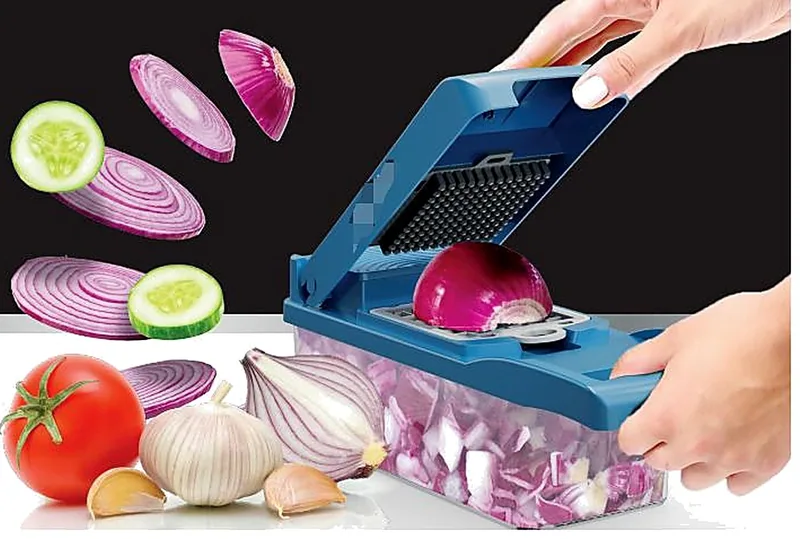
A dicer and slicer with a container and interchangeable blades, listed for potato, onion and cucumber. This guide covers who sells it best, how to specify it and which Canadian points to settle before you import.
What the Multi-Function Vegetable Dicer is
The Multi-Function Vegetable Dicer (TVD-1780) is a dicer and slicer with a container, interchangeable blades, and a stated use for potato, onion and cucumber. In plain terms, you push or press produce through a blade grid, and the cut pieces fall into an attached container, which saves a cutting board and keeps the work tidy. The interchangeable blades are what make it multi-function: swap one in and you dice, swap another and you slice. We do not publish blade counts, grid sizes, container capacity or materials here. Those are confirmed on your written quote, and a free account on the site shows the full specifications.
Who buys it
Kitchenware retailers sell it as a prep-time saver, and it demonstrates well in-store: a shopper can see produce become even cubes in seconds. Discount and variety chains use it as a TV-style gadget with a strong box. Online sellers have an advantage because the benefit, uniform cuts without skill, shows clearly in a short video. Meal-prep and family-oriented retailers pair it with storage containers. Small food businesses such as delis, salad bars and school kitchens sometimes buy a few for prep, though those buyers should confirm what their health unit expects on food equipment and should ask about the factory's rating for repeated heavy use, which is not stated.
Reading the listed features
- Dicer and slicer. Two functions in one item means one set of blades must handle both. Ask how many blade sizes come in the box and whether a blade is fitted in the unit as shipped.
- Container. A built-in container makes the dicer self-contained, but the size limits batch size and the container material needs a food-contact answer. Ask for the capacity and whether the container has a lid.
- Interchangeable blades. Blade changes are where the product is most likely to fail or injure a user. Ask how blades lock, whether there is a pusher or guard to protect fingers, and whether a blade-storage spot is included.
- Potato, onion, cucumber. These are firm, watery or fibrous vegetables, which is a decent test range. They do not tell you about tomatoes, soft fruit or cheese, so do not advertise those without testing.
A checklist to adapt for your quote
- Number and type of blades, dice sizes, and whether extra blade sets can be bought later.
- Container capacity, lid and overall footprint, plus the weight of the boxed product.
- Material of frame, container, pusher and blades, and the stainless steel grade of any metal part.
- Dishwasher or hand-wash guidance from the factory; no rating is stated here.
- Food-contact test reports for every part that touches produce.
- Safety features: finger guard, non-slip base, blade lock.
- Retail box type, barcode, instruction language and carton quantity.
- Minimum order, sample availability and lead time.
How it differs from neighbouring products
The pull-cord hand food chopper (TVD-1779) produces rough, mixed pieces in a bowl, ideal for garlic, herbs and onion, while the dicer produces even cubes and slices, which suits potatoes, cucumbers and salad prep. A shop that stocks both can sell them as a pair: chopper for fine and rough work, dicer for tidy cuts. The stainless steel apple slicer (TVD-10736) is a smaller, carded gadget for fruit only. For a cutting surface, the Bamboo Cutting Boards (TVD-2832) are a natural companion, and the Collapsible Round Colander (TVD-1781) completes a prep-and-rinse display. For the colander, see our collapsible colander guide.
Canadian notes
The dicer as described is manual, with no electrical part, so electrical certification would not apply. If a version has a motor, tell us. The food-contact questions are the heart of it: the Food and Drugs Act prohibits selling food in or with materials that may make it harmful, and Health Canada does not pre-approve kitchenware, so buyers ask the factory for food-contact test reports for plastics and metals. The Consumer Products Containing Lead Regulations set lead limits that include kitchen utensils. Exposed blades fall under general consumer product safety rules under the Canada Consumer Product Safety Act, which prohibits products that are a danger to human health or safety; warnings and finger protection matter. Boxed goods need bilingual product identity and net quantity under the Consumer Packaging and Labelling Act, and Quebec retailers will ask for French on the box and the instruction sheet under the Charter of the French language. Rules change; confirm with the authority or your customs broker. This is not legal advice.
No certification is on file for TVD-1780. We confirm certification status and supply the documents with the quote before you order. The matching certification and compliance post for the vegetable dicer goes through the documents in detail.
Packaging, breakage and freight
A dicer with a container and blades is a bulkier box than most gadgets, so ask for the carton quantity and size early and use the landed cost calculator to estimate delivered cost. Shipping runs through Vancouver or Prince Rupert by ocean, then rail and truck. Ask the factory whether blades are individually wrapped and whether the box is strong enough for retail handling, as dented boxes are a common reason for markdown. For tax on the delivered goods, see the sales tax by province guide. Duty depends on tariff classification and origin, which our customs broker confirms before we quote delivered cost.
How to order
Every order is quoted in writing for price, specification, certification status and documents, packing, lead time and delivered cost. Samples are available on most items, and many lines have low trial minimums. Payment is 30% deposit and 70% before release, with delivery to your store or warehouse across Canada. Read how ordering works, browse the kitchen gadgets and knives line, or send a quote request for TVD-1780.